It's said that every cloud, black as it might be, has a silver lining. Hopefully, this applies to something as ominous as the report of four new cases of fatal chronic wasting disease CWD among whitetail deer in Hampshire County, W.Va., just across the Potomac from Maryland's popular Green Ridge State Forest. This brings the total to nine in that county.
That state's Division of Natural Resources, which acknowledges preliminary testing on the latest four deer indicated CWD was to blame, said the testing was done as part of an "ongoing intensive surveillance effort." CWD testing was conducted by the Southeastern Cooperative Wildlife Disease Study located at the University of Georgia's College of Veterinary Medicine.
How can there be a silver lining to such news? All nine afflicted deer were from the same small area near the small town of Slanesville, a popular hunting grounds for both residents and non-residents. This could well mean the outbreak remains contained in the area.
How did it reach Hampshire County? It could well have arrived in a pickup truck carrying a diseased whitetail taken by hunter or poacher from another area. Or, could it be a spontaneous outbreak that could have happened in some states hundreds of miles from where CWD was known to be present? So much remains unknown about the disease.
CWD, first recognized in 1967 in Colorado, has subsequently been found in captive deer and elk herds in nine states and two provinces of Canada - and in free-ranging herds in 11 states and two provinces. Until discovered in New York and West Virginia last year (September in West Virginia), CWD cases were pretty much confined to the West and Midwest.
When West Virginia deer first tested positive in late summer of last year, the DNR immediately implemented its CWD-Incident Response Plan - and has been engaged in intensive surveillance efforts designed to determine the spread and prevalence of the disease.
From September through the past April, 1,317 Hampshire County deer were tested. The samples consisted of 1,016 hunter-harvested deer bagged during the past season, 216 deer taken by DNR personnel in '05 and an additional 85 taken by the department in '06. CWD was not detected in any of the examined hunter-harvested deer the past fall.
All four of the latest cases came from the 85 taken by DNR this year. One of the deer that tested positive late last year was a road kill.
"Analysis of the CWD surveillance data indicates the disease appears to be found in a relatively small geographical area located near Slanesville less than 10 miles from the Maryland line." said DNR Director Frank Jezioro. "From a wildlife disease management perspective, we consider this to be encouraging news.
"Based upon these CWD surveillance findings, we are taking the steps necessary to implement appropriate management actions designed to control the spread of the disease, prevent introduction of the disease and possibly eliminate the disease from the state."
Jezioro declined to list what the actions would be, but we will probable see more DNR-taken deer there in the near future. Three management options outlined by the department for use within the afflicted area of Hampshire County include:
Lower deer population levels to reduce the risk of spreading the disease from deer to deer by implementing appropriate antlerless deer hunting regulations designed to increase hunter opportunity to harvest female deer.
Establish reasonable, responsible and appropriate deer carcass transport restrictions designed to lower the risk of moving the disease to other locations.
Establish reasonable, responsible and appropriate regulations relating to the feeding and baiting of deer within the affected area to reduce the risk of spreading the disease from deer to deer.
Source: Water and Woods News

Tuesday, June 27, 2006


Sunday, June 25, 2006
Infectious prions found in deer meat
Research finds the matter, which causes chronic wasting disease, in muscle. It had been thought to be only in nervous-system tissue.
By Katy Human
Denver Post Staff Writer
A person who eats venison could swallow the proteins shown to cause a deadly brain disease in deer, elk and moose, researchers reported today.
Their article in the journal Science represents the first time scientists have found the proteins that cause the affliction, chronic wasting disease, in the meat and muscle of deer.
Previously, it had been found only in the brain, spinal and lymph tissues. Health officials have long reassured hunters they would not be exposed to the disease as long as they did not touch or eat those parts.
A Colorado expert on the disease said the discovery doesn't necessarily mean that Colorado hunters should change their practices or that venison eaters should change their habits.
There's still no evidence that a person has caught a brain disease by eating a sick deer, said the expert, Mike Miller, a veterinarian with the Colorado Division of Wildlife.
In the Science article, Colorado and Kentucky scientists said they had found "significant" amounts of disease-causing prion proteins in the hamstring muscle of deer dying from chronic wasting disease.
When injected into laboratory mouse brains, the muscle tissue caused wasting disease.
"People who are handling or consuming deer meat are going to be at risk to consuming prions," said Glenn Telling, a molecular biologist at the University of Kentucky and co-author of the study.
Scientists still don't know whether the deer prions can sicken people, Telling said, but the finding "raises the stakes."
Prions that cause a similar disease - mad cow - have never been found in cow muscle tissue.
Even so, a few people who ate mad-cow-infected beef have caught and died of a deadly brain disease, called variant Creutzfeldt-Jacob.
"People are more likely to run a risk of exposure to chronic wasting disease proteins" through deer meat than they are to ingest mad-cow proteins by eating beef, Telling said.
"It's clearly there in the meat, but in very small quantities," said Miller, also a co-author of the new paper.
"We've been saying for 10, 11 years now, 'Don't consume deer or elk that appear to be sick,"' Miller said. "If anything, this confirms that our standing recommendations are appropriate."
John Pape, an epidemiologist with the state health department, agreed.
He just submitted a paper showing that the incidence of Creutzfeldt-Jacob disease in Colorado is no higher than it is elsewhere, even in places without chronic wasting disease.
"We can't exclude that possibility, that a rare (human) case could occur, but it's certainly not occurring at a high rate," Pape said.
The new study suggests that experts can monitor the incidence of chronic wasting disease by taking muscle samples from wild animals, Telling said.
Previously, the only reliable tests for the disease involved killing deer, elk or moose to test brain, lymph or spinal tissue.
By Katy Human
Denver Post Staff Writer
A person who eats venison could swallow the proteins shown to cause a deadly brain disease in deer, elk and moose, researchers reported today.
Their article in the journal Science represents the first time scientists have found the proteins that cause the affliction, chronic wasting disease, in the meat and muscle of deer.
Previously, it had been found only in the brain, spinal and lymph tissues. Health officials have long reassured hunters they would not be exposed to the disease as long as they did not touch or eat those parts.
A Colorado expert on the disease said the discovery doesn't necessarily mean that Colorado hunters should change their practices or that venison eaters should change their habits.
There's still no evidence that a person has caught a brain disease by eating a sick deer, said the expert, Mike Miller, a veterinarian with the Colorado Division of Wildlife.
In the Science article, Colorado and Kentucky scientists said they had found "significant" amounts of disease-causing prion proteins in the hamstring muscle of deer dying from chronic wasting disease.
When injected into laboratory mouse brains, the muscle tissue caused wasting disease.
"People who are handling or consuming deer meat are going to be at risk to consuming prions," said Glenn Telling, a molecular biologist at the University of Kentucky and co-author of the study.
Scientists still don't know whether the deer prions can sicken people, Telling said, but the finding "raises the stakes."
Prions that cause a similar disease - mad cow - have never been found in cow muscle tissue.
Even so, a few people who ate mad-cow-infected beef have caught and died of a deadly brain disease, called variant Creutzfeldt-Jacob.
"People are more likely to run a risk of exposure to chronic wasting disease proteins" through deer meat than they are to ingest mad-cow proteins by eating beef, Telling said.
"It's clearly there in the meat, but in very small quantities," said Miller, also a co-author of the new paper.
"We've been saying for 10, 11 years now, 'Don't consume deer or elk that appear to be sick,"' Miller said. "If anything, this confirms that our standing recommendations are appropriate."
John Pape, an epidemiologist with the state health department, agreed.
He just submitted a paper showing that the incidence of Creutzfeldt-Jacob disease in Colorado is no higher than it is elsewhere, even in places without chronic wasting disease.
"We can't exclude that possibility, that a rare (human) case could occur, but it's certainly not occurring at a high rate," Pape said.
The new study suggests that experts can monitor the incidence of chronic wasting disease by taking muscle samples from wild animals, Telling said.
Previously, the only reliable tests for the disease involved killing deer, elk or moose to test brain, lymph or spinal tissue.
Saturday, June 24, 2006
Weapon Choices for Deer Hunters
 Get a few hunters together in a deer camp and start talking about the best weapon choice for deer hunting and you soon will have, at times, a heated and opinionated debate going. Each hunter has his own favourite weapon choice and within that weapon category his favorite set up. There is no one single best weapon for every situation.
There are many variables to be considered in choosing a weapon for deer hunting. Such as the terrain the hunter hunts in, what hunting method he prefers and finally what's the hunters personal preference in weapon type, stile and even brand name. One aspect that all weapons have in common is that they are only as good as the person operating them.
If I could give only one single advice to every beginning hunter, and seasoned hunter for that matter, then it is this.
Before you make you decide to buy any weapon for hunting purpose invest a considerable amount of time to research and try as many different weapons as possible. Forget for a moment the brand name and choose a weapon which fits you physic and feels comfortable to carry and handle. Once you get the weapon of your choice home don't put it in the cabinet for all to look at it. Instead keep practicing with it all year round and spend as much time to get to know your weapon as possible. In order to become a proficient shooter you have to be as familiar with your weapon as you are with yourself. In fact the weapon has to become an appendage of your body. Practice the one shot mentality, because under field conditions that is all you will get.
The following list is by no means complete but rather should be viewed as a rough guideline. Also make sure that you study the hunting regulations of the area, state or province you wish to hunt. The hunting regulations often will have specific requirements for weapons, their storage and transport.
Rifles - there are many to choose from, I just listed a few here.
Light End:
.243 Winchester, 6mm Remington, .250 Savage,.257 Roberts, .260 Remington, 30-30 Winchester.
Medium:
.270 Winchester, .280 Remington, 7x57 Mauser, 7mm-08 Remington, .284 Winchester.
Heavy End:
.308 Winchester, 30-06 Springfield, 7mmRemington Magnum.
Authors note. -My personal choice is a 7mm-08 Remington, which I use in forested areas and other spaces with thick vegetation where shots are at close range. As a long-range rifle for deer in the open plains I like the flat shooting 7mm Remington Magnum.
Pistols (Handguns are not legal in every U.S. State and Canadian Province. Make sure you read the regulations before taking a handgun into the field.)
Light End:
.357 Magnum.
Medium:
.41 Magnum, .44 Remington Magnum.
Heavy End:
.454 Casual
Bows (This includes modern compound and traditional recurve and long bows. Read the hunting regulations for specific recommendations of draw weight and let-off percentages, such regulations can vary from state to state or provinces. In most areas it is legal to use a bow with a draw weight between 40lb. to 45lb. minimum.)
Light End:
40lb. pound draw weight.
Medium:
45lb., - 50lb.,- 55lb. draw weight.
Heavy End:
60lb.,- 65lb.,- 70lb. draw weight.
Authors note. - My choice is a 65lb. compound bow with a 75% let off. For me this bow is easy to draw and hold when I have to wait for the perfect shot at full draw.
Crossbows (The very exiting news is that more U.S. Wildlife Agencies legalize this traditional archery weapon for all hunters to be used as a very effective hunting tool. However, I recommend strongly that you check with your local wildlife agency about the legal use for non-physically challenged persons.)
Light End:
110 pounds draw weight.
Medium:
125 pounds draw weight.
Heavy End:
175 pounds draw weight.
Authors Note. - Personally I prefer the heavy end cross bow to hunt with. But generally speaking any crossbow is a very effective weapon to hunt deer with. I am very exited that there are more opportunities available to hunt with this weapon that has an undeserved negative reputation.
Muzzleloaders (This includes all muzzleloader firearms, including black powder handguns, modern in-lines, percussion cap locks and flintlocks. Please check with the hunting regulations for more detailed information, regulations and special seasons.)
Light End:
.45 Calibre.
Medium:
.50 Calibre
Heavy End:
.54 Calibre
Authors note. - The .50 calibre muzzleloader is a very good choice for deer hunting with round balls, conical bullets and sabboted pistol bullets. It has moderate recoil depending on the load combination.
Shotguns
Light End: 20 gauge.
Medium: 12 gauge.
Heavy End: 10 gauge.
Authors note: - My choice of shotgun is a 12 gauge dedicated (centre fire rifle style) slug gun with sabboted slugs. Personally, I do not recommend using "buck shot" as I feel it is not as efficient as a well-placed slug. Also a slug gun is a short range weapon shots should be kept just slightly over 100 yards with a well tuned gun, preferably under 100 yards. Slug guns are perfect "brush guns".
CWD (Chronic Wasting Disease)
 Here at Outdoors with Othmar Vohringer and Whitetail Deer Passion we recognizes the current threat that chronic wasting disease (CWD) poses for the deer, elk and perhaps other wildlife plus to the heritage of hunting big game in general that could occur if this illness should spread further. In several regions of North America this threat has become already a sad reality. This is why we here at Outdoors with Othmar Vohringer and Whitetail Deer Passion have compiled an informative resource of information so that the visitors to our website can learn more about this threat and what they can do to help in the prevention of the spread of CWD.
As hunters and conservationists we at Outdoors with Othmar Vohringer and Whitetail Deer Passion feel it is our duty to our fellow outdoor and hunting enthusiasts to provide the information available without the usual hype, rumours and hearsay. Instead we provide the facts, as they are known to us from reputable sources in an effort that you can take the necessary precautions and to learn what various state and province agencies in the USA and Canada are doing to combat this problem. For most hunters, especially those who hunt in areas where CWD has not been found do not be concerned about CWD and still can enjoy the upcoming hunting season. But we at Othmar Vohringer Outdoors would like to encourage all hunters who care about wildlife and conservation as much as we do, to get as much information and education about this illness as possible, to take all the necessary precautions and help their local wildlife management agencies in any way they see fit in preventing the spread of CWD in an effort to secure our priceless natural renewable resources for generations to come.. Thank you for being a true hunter and conservationist, we count on you and so do our children and future generation hunters.
Bellow we provide you with the answers to most CWD questions.
**************
 What is CWD?
CWD is a neurological (brain and nervous system) disease found in deer and elk in certain geographical locations in North America. The disease belongs to a family of diseases known as transmissible spongiform encephalopathises (TSE) or prion diseases.
This disease attacks the brain of the infected deer or elk and produces small lesions that result in the death of the animal. While CWD is similar to mad cow disease (BSE) in cattle and as scrapie in sheep, there is no known relationship between CWD and any other TSE of animals and, or people
.
How is it spread?
It’s not known exactly how CWD is spread. It is believed that the agent responsible for the disease may be spread both directly (animal to animal) and indirectly (soil or other surface to animal). It is thought that the most common mode of transmission from an infected animal is via saliva and feces.
Where has it been found?
CWD is known to infect wild deer and elk in north-eastern Colorado and southern Wyoming, and wild deer in western Colorado, western Nebraska, south-western South Dakota, south-central New Mexico and west-central Saskatchewan. It has been diagnosed in game ranches in Colorado, Nebraska, South Dakota, Montana, Oklahoma, Kansas, Alberta and Saskatchewan.
Is it dangerous to humans?
There is currently no convincing evidence that the agent of CWD affects humans. However, public health officials recommend that human exposure to CWD agent be avoided as they continue to research the disease.
What precautions should hunters take?
Health officials advise hunters not to consume meat from animals known to be infected with the disease. Boning out meat is recommended. In addition, they suggest that hunters take normal simple hygienic precautions when field dressing carcasses.
How can you tell if a deer has CWD?
Infected animals may not show any symptoms of the disease. In some stages of the disease, however, infected animals begin to lose bodily functions and display abnormal behaviour such as staggering, disorientation or standing with very pore posture. Animals may have an exaggerated wide posture, or may carry the head and ears lowered. Infected animals become very emaciated (thus wasting disease) and will appear in very poor body condition. Infected animals will also often stand near water. Drooling or excessive salivation may be apparent. Note that these symptoms may also be characteristic of diseases other than CWD.
What should I do if I see a deer with CWD?
Unless your state or province wildlife agency or other appropriate authority has issued other instructions and/or regulations, you should accurately document the location of the animal and immediately contact the nearest officer or employee of the State or Province Wildlife Agency. Do not attempt to contact, disturb, kill, or remove the animal.
Can I have a deer tested?
In general, the answer is no if you live in an area where CWD has not been documented. Testing is currently only available in areas where CWD has been detected in wild deer. Much effort is being devoted to increasing the laboratories that are certified to do the testing.
Is the meat safe to eat?
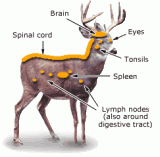
While the agent that produces chronic wasting disease in deer and elk has not been positively identifies, there is strong evidence to suggest that abnormally shape proteins, called prions, are responsible. Research completed to date indicate that the prions accumulate in certain parts of infected animals-the brain, eyes, spinal cord, lymph nodes, tonsils and spleen. Based on these findings, hunters are recommended to not eat meat from animals known to be infected with CWD. Hunters in CWD areas are also advice to bone out their meat and to not consume those parts where prions likely accumulate.
What's being done to combat CWD?
Efforts to address CWD are accelerating rapidly. In facilities with captive animals known to have or to have been exposed to CWD, management is concentrating on quarantining or killing of every animal and burning of all carcasses. In some cases around captive populations, double fencing is recommended to prevent direct contact between captive and wild animals.
In wild populations, the management option recommended is to reduce the density of animals in the infected area to slow the transmission of the disease. This is being done by selective culling of animals suspected to have been directly exposed to this disease. In Colorado, Nebraska and Wisconsin large numbers of animals are being killed to reduce density of animals and thus slow the transmission of the disease.
There is still a large need for research on the disease as many questions go unanswered. There s also a need for increased funding to support additional laboratories for testing animals for the disease. Just about every U.S. State and Canadian Province wildlife agency is now planning an increased effort at surveillance to detect if CWD is present.
Many state and province agencies have banned the importation of deer and elk into their state or province.
Some U.S. States and Canadian Provinces have also halted intra-state/province movement of deer and elk has banned supplemental feeding programs. Colorado has implemented regulations that allow only boned meat, quarters (without spinal column or head) or processed meat from deer or elk to be transported out of certain areas with CWD. Clean skull plates with the antlers attached can also be removed from an infected area. Check with a state/province wildlife agency in the state/province where you hunt to determine if they have enacted similar restrictions.
For more up-to-date information please visit:
The CWD.Org. Website
Chronic Wasting Disease is a joint project of the Boone and Crockett Club, the Mule Deer Foundation and the Rocky Mountain Elk Foundation. These non-profit wildlife conservation organizations formed the Chronic Wasting Disease Alliance in January 2002 to address CWD. Other organizations have since joined the Alliance.
Updates about CWD on this Blog:
West Virginia CWD
Infectious Prions Found in Deer Meat
Friday, June 23, 2006
Whitetail Deer (Odocoileus virginianus)
 Description:
The whitetail deer is without question the most favourite game animal of North America. There are two name spellings “Whitetail deer” and “White-Tailed-Deer” for this game species. Most hunters refer to the whitetail deer affectionately as "whitey". The whitetail deer is a relatively small animal with short ears and relatively long tail. The name comes from the white underside of the tail and backside. If the whitetail deer is alert it lifts its tail (called flagging) and the white “mirror” is displayed, thus the name whitetail deer. The males (bucks) have antlers consisting of two main beams, one on either side of the skull, these main beams swing from the skull back and then in a semi circle to the front. Several usually unbranched tines (points) come of the main beam. Depending at the area where whitetail deer’s come from their colour can vary from dark brown to reddish brown. Usually in the southern parts of North America the whitetail deer are reddish brown and of slender stature. In the northern parts like Canada the deer are darker brown and of a stouter stature with heavier mass in the antlers. The antlers are a bony structure, which is shed in the winter. Depending on range area this can be as early as November or as late as January. The antlers begin to grow back in the spring when the deer has access to a lot of nutritious food that is needed for the growth of the antlers.
Habitat & Diet:
Unlike other deer subspecies the whitetail deer lives in a wide range of habitats it is this adaptability that made the whitetail the most successful gmae species in North America. Unlike to some other deer species the whitetail der is not a migratory animal but stays in a relaitvily, depending on the availability of food, in small territory. From the swampy river bottoms of Alabama to the hardwood lots and agricultural fields of the American Midwest right up to Canada’s pine forests and rocky the slopes the whitetail deer calls a wide range its home. Unlike common believe the whitetail deer is not a deep forest dwelling animal. They like semi open brushy habitat near and around rivers and wood lots where they can find choice browse and retreat quickly into the protective cover again. The whitetail deer’s diet is as varied as its habitat range and changes from season to season. The most preferred food, where available, is agricultural crop such as corn and beans. Deer also eat grass, berries, fruit; an old apple orchard is irresistible to any deer. Other so-called woodland food sources are acorns, persimmon but also saplings, fungi, bark and many other things. Like all ruminants the whitetail deer has two main feeding times within 24 hours. These are early in the morning at dawn and then late in the day at dusk again. During the day the deer likes to lay on an elevated point, such as a ridge top, as chews its cut.
Reproduction:
The whitetail deer are polygamous. The rut (breeding) phase begins in early fall and continuous trough the early winter. The start of the rut varies from region to region. For example, in the southern part of the U.S.A. the rut may start as early as late August early September. Whereas is Canada the rut may start as late as the beginning of November. In the past it has been believed that the beginning of the rut is connected with the moon phase. Today we know that the rut is triggered by a sharp trop in the temperature. It can be safely estimated that the beginning of the rut usually begins around the time of the first cold snap or frost of the year. In most parts of North America the female (Doe) is breed by the end of January. After a gestation period of about 7 month one to two young deer (fawn) are born. In the first 10 to 14 days the mother will hide the fawns usually in tall grass and returns to them several times a day to nurse them. The fawns are odourless in the first two to three weeks of their life and when the mother is not with them they fall into a motionless, coma like, state and thus can stay undetected from most predators. To further enhance staying undetected the fawns are born with a white doted fur and a light reddish brown base colour that makes them almost invisible in tall grass or brush, even at very close distance. At about two weeks of age the fawns are strong enough to follow their mother but will retain the spotted fur until they molt for the first time in early fall by which time they are usually weaned too. Sexual maturity is usually reached not until the second year by a doe and the first year by a buck. However, if conditions are excellent a female fawn may come in her first oestrus cycle in the first year and will give birth in the following spring. It is however rare that a whitetail deer’s first-born fawn will survive longer than a few weeks.
Common Hunting Methods:
Whitetail deer are pursued with rifle, slug shotgun, bow and arrows, handguns and muzzleloaders. There are many different tactics that can be employed when trying to get a whirly whitetail harvested. These include spot and stalk, deer driving, stand hunting, blind hunting. The combinations of rattling, scent lure, baiting and calling are sheer endless. I can say with all confidence that for no animal have been so many specific hunting strategies developed than for the whitetail deer. Depending on the area and the structure of the land from the deep dark forests of Michigan, the cornfields and small woodlots of Illinois to the wide open grass lands and river bottoms of Texas and Colorado, there seems to be a special strategy and tradition to hunt this most popular of all game animals.
A keen sense of smell and a good eyesight mixed with the ability to blend completely in to the background of their surroundings make the whitetail deer extremely challenging to hunt.
Subscribe to:
Posts (Atom)
