Thursday, August 24, 2006

News: B&C Monster Bucks of 2006

With the upcoming hunting season fast approaching how about a little teaser to get you even more exited? The Boone and Crockett Club just released the new entries to their trophy record book.

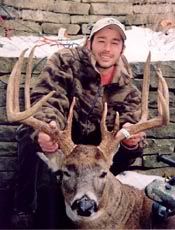
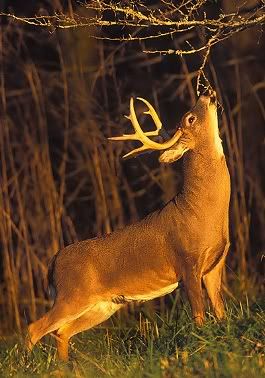
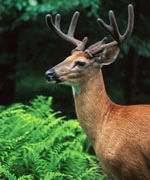
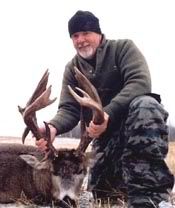
The trophy buck that peaked my interest right away was the monster buck taken in Alberta, Canada. This very unusual buck was taken by Scott Reeves last fall in Alberta. While only pushing the 11-1/2 inch mark in greatest spread, this deer has 25-inch main beams and reportedly scores in the 186-range as a non-typical! What a weird looking buck. In this case it was the antler mass that gave him a 186-point ranking. Truly a unique trophy. Alberta is known all over North America for its trophy sized whitetail deer. Another fine Canadian Province I have earmarked in my calendar for an upcoming hunting trip in the future.


The next buck I show you has been taken in my old hunting grounds of Illinois. Having lived in that deer hunter paradise for 10 years I know how big these corn fed deer can grow. Illinois consistently produces trophy deer every year. Dave Voorhees arrowed this all-time records book giant, scoring 170 B&C, on December 23rd. He was also able to get great velvet footage of it earlier in the year, as well as video of the hunt. This great 5x6 has over 6-inch bases! The Voorhees buck was taken in Peoria County, not far from where I use to live. I think I will go back there one of these days. Man, I am “home sick” now.

Tags: ,

Saturday, August 19, 2006

A Year in a Whitetail Deer’s Life

Spring
Spring is the season of new beginnings. The big event is the birth of fawns in late May or June. Triggered by increasing amounts of daylight, bucks begin to grow new antlers. Spring is a tranquil time when deer relax and replenish their bodies from the long, harsh winter.
Come spring, some whitetails must reacquaint with their environment. Northern deer begin the trek back toward their warm-weather range. This may take a few days or a few weeks. Deer usually inhabit the same winter and summer ranges all their life. However, favorable spring weather allows deer to explore and extend their home ranges.
Does and bucks must also readjust their social relations. Some deer didn't survive the previous fall and winter-they were shot by hunters, hit by cars, killed by predators or succumbed to harsh weather. Buck groups may find themselves without a dominant buck. Although they are passive during the spring, bucks still have ways of establishing dominance. Since bucks lack large, hard antlers, they use their front feet to spar with one other.
A few days before giving birth to fawns, does return to familiar fawn-rearing areas. Since does have some control over when they birth, they spend time looking for a suitable area away from predators. A doe occupies her secret spot for about 3 hours after dropping one or 2 fawns, giving the young time to associate with their mother. Fawns learn to walk and follow mama quickly.
Does are alert and aggressive as they protect their fawns. They ward off predators and even other deer. Does frequently leave fawns alone as they venture out to feed. If a fawn senses danger it utters a bleat or bawl. The mother comes running.
Deer enjoy a wide variety of foods in spring. Much of the foliage is rich in nutrients-a welcome change to the twigs deer were forced to eat the previous winter. The nutrients help replenish a deer's body. Pregnant does increase their food intake.
Deer also consume a large amount of salt during the spring. Why is not clearly understood. Some researchers believe that the increased nutrients in a deer' s diet cause a sodium loss through urination. Thus, deer replace it with salt.
Deer shed their thick winter coats in spring. This process is called molting, and it occurs again prior to winter. Molting is thought to be caused by many factors, including temperature and light.
Summer
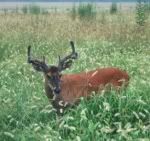
Summer is the lazy season for deer. Life continues as it was in the spring. Fawns grow and learn about the world from their mothers, which they now recognize by scent. The testosterone level of bucks is low, so males aren't all that active. Bucks spend the summer learning about other bucks in their herd and storing fat for the winter.
The antlers of a buck become prominent and covered in soft velvet. Without hardened antlers, bucks spar for dominance with their forelegs. Some researchers believe that the dominant hierarchy is established in the summer.
Summertime is not without its problems. Droughts can hit on the local or regional level, impacting the whitetail's food supply. Some deer share summer range with livestock and compete for food. But for the most part, these things don't cause deer too much trouble.
Fall
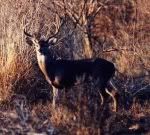
Autumn brings a distinct change in the whitetail's behavior. The passiveness of spring and summer is gone, replaced by the frenzy of the breeding season. Mature bucks become aggressive and roam widely in search of does.
The rut, or the whitetail's breeding season, occurs in the fall. The time before mating, or the early pre-rut, is characterized by groups of does, bucks and fawns grazing together. Bucks mingle with does to showboat their new antlers.
Throughout the pre-rut, the does' reproductive organs adapt to handle breeding and pregnancy. Less daylight triggers an increase in the bucks' testosterone, the hormone responsible for, among other things, antler maturation. Once antlers harden, the velvet that covers them dies and dries up. Older bucks generally rub off the velvet before younger males do.
To establish dominance in a hierarchy, bucks engage in a behavior called sparring. Two animals lock their antlers and push until one buck backs down, thus yielding dominance to the other buck. It should be noted that sparring is not fighting. Once a buck gains dominance, he maintains his position in the hierarchy by staring down other bucks. If another buck rises to the challenge, the two deer engage in a fight, clashing antlers and pushing until one buck backs down.
In fall, a buck uses "signposting". He scrapes and rubs, leaving his scent on the ground and on trees for does and other bucks to smell. When a buck and doe hook up, they chase before mating. After mating, a buck may graze with a doe for a while before darting off to find another mate.
The rut leaves a buck frail and tired. Sometimes a dominant buck is so weak that he can barely survive the winter. This gives younger bucks a chance to breed does that come into late estrus, generally in December. Bucks use up testosterone during the breeding season, and this causes their racks to fall off in the winter.
Fall is a time of new experiences for fawns. They watch and learn all the social interaction and posturing within a herd. Fawns get used to seeing bucks with full racks, and witness fights and mating.
In the fall, deer seek out foods rich in carbohydrates. Acorns, beechnuts, pecans, apples and other soft and hard mast, in addition to crops, help pack on fat that carry deer through the rut and winter.
Winter
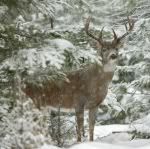
The effects of winter on deer are much greater in the North than in central and southern states. In order to escape the cold and snow, some deer migrate 50 miles or more to suitable winter range. Food supplies are often scarce. Deer survive on whatever twigs or brush they can find. Some older bucks, worn out from the rut, may die. Doe and fawns may perish from malnutrition or predation. The survival of a deer depends primarily on how well it prepared during the other three seasons. One good thing: The metabolism of whitetails slows down in the winter, so the animals don't have to eat as much to keep their bodies going.
The buck's thick winter coat keeps him warm. The dark-gray color helps absorb the sun's heat. In extreme cold, a deer tightens its skin muscles and the coat hairs stand on end. This traps air near the skin's surface, insulating a deer and keeping it warm. This process is called piloerection.
During winter, bucks once again form social groups. Younger deer learn how to survive the harsh conditions from the older deer in the herd.
Many biologists believe that lack of nutrition, not cold weather, depletes whitetails. In many areas deer may go days without eating. In this case, deer derive their energy from fat reserves that they built in the fall. Nowadays in farming areas, many deer stay healthy by feeding on leftover grains.
The struggle for survival forces many deer to congregate in one area, called a "deer yard". A yard is located where there is some food around, and where the temperature is relatively warm--for example on a south-facing slope. Regardless of social grouping, deer congregate in a yard. Here, fights can break out over the tiniest morsel of food. Fawns usually suffer. They can't reach food on high branches, and bigger, older deer bully them.

Saturday, August 12, 2006

Signpost Communication

In this article we will look at the different signs deer make and there meaning. In general signpost communication is both, a visual and olfactory marker for other deer. Signposts include both rubs and scrapes. The deer uses these signposts to either, convey a message to other deer or as an orientation marker, similar to directional signposting we use on our roads. A smart hunter will learn how to interpret and understand deer sign. Understanding deer sign is as important to a successful hunter as understanding a deer’s behavior in correlation to food sources, topography, seasonal and environmental changes.

Scrapes
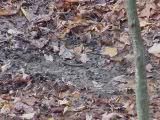
A scrape is an area of exposed earth up to 6 or 8 feet in diameter that a deer has swept clear of leaves, twigs and other debris with its front feet. Deer leave their scent at scrapes in several different manners. They urinate in it and as they step it in leave glandular scent behind. Despite popular believe that only bucks make and use scrapes, does make and use scrapes too. One way to view a scrape is that it is a check in station. Deer passing through the area will check in or visit the scrape to leave their scent (urine) and see what other deer have recently been in the area. Both bucks and does will visit active scrapes. There are several kinds of scrapes.

Primary Scrape
A large scrape made in an area that does frequent or where several doe trails converge. A buck will often urinate in these scrapes and leave other glandular scents in the area. These scrapes could be described as boundary signposts. For hunting purposes these scrapes are not much use to me other than that they tell me that this area holds a dominant buck.

Satellite Scrape
A scrape made by a mature buck along edge cover or buck travel corridors. Some hunters believe that these secondary scrapes are used mostly by the buck population to keep track of each other. However, I have witnessed many times that does too urinate in these scrapes to “advertise” their estrus status to passing bucks. Several satellite scrapes along an edge are called a scrape line. Generally, I do not hunt scrapes but they do tell me by increased activity (scraping) when the rut is approaching.
Primary and Satellite scrapes are always placed on edges and in plain sight, they are meant to be very visible. These scrapes can always be next to a tree trunk or bush with an overhanging branch or two about four feet of the ground. Typically the branch above the scrape will be chewed on by the deer to leave yet another scent marks. In addition bucks will rub their heads on these braches and by doing so deposit glandular scent on the branches.
The scrapes can appear from the size of a dinner plate to several feet in diameter. The size of the scrape is no indication of the size of the buck that made the scrape.

Random Scrape
A scrape made randomly by a buck along a trail. These secondary scrapes feature not always a overhead licking branch. Most hunters believe that most satellite scrapes are made by immature bucks and are never revisited by the deer that made the scrape or any other deer. Such scrapes are, also made by large bucks in the pre-rut out of frustration. The pre-rut is a very tense time for bucks when they start to become more aggressive and intolerant of each other, the does are not in estrus yet and so bucks let off some steam by making these “frustration” scrapes and trash their horns against brush and saplings. Again, for hunting proposes these scrapes are of no value to me other than that they tell me that there are bucks in the area.

Mock Scrape
A mock scrape is one that has been made by a hunter in an area that deer frequent. Some hunters will visit mock scrapes year around and freshen them with commercial deer scent. The purpose of a mock scrape is to create a signpost that brings deer closer to your stand location and give the resident bucks the impression that another buck invaded their territory. By making a mock scrape the hunter has to pay attention to deer travel. It makes no sense to try and attract a buck with a mock scrape in an area where he doesn’t travel. No deer will go out of its travel way to come to a scrape.

Active Scrape
An active scrape is one that is being regularly maintained by multiple deer. A scrape that is not regularly visited is referred to as an in-active scrape. An active scrape has fresh turned soil and is free of debris such as leafs and twigs and it has a strong smell of urine. When a hunter approaches a scrape to “juice” it up with deer urine based scent he should use utmost caution not to leave any human odors near the scrape. Most hunters use rubber cloves to handle scrapes and make sure that they do not step into the actual scrape.

Rubs
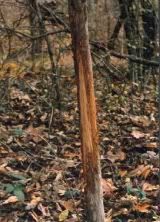
A rub is an area on a tree 1 to 3 feet off the ground where a buck has rubbed the bark off the tree by using it to remove the velvet, polish his antlers and strengthen his neck muscles. It is often said that all bucks rub little trees, but only big bucks rub big trees, however I have made no observations to support such claims. I have seen small bucks rubbing on large trees too. One basic rule should be applied to rubs. While a big buck can make small and large rubs, a small buck only makes small rubs. In my opinion, there are only three types of rubs; incidental, cluster and sign post rubs.

Incidental Rubs
Incidental are just as the name implies. Incidental. They mean nothing and have no value for our scouting purpose. Incidental rubs appear early in the season and are numerous. They are not large and appear either as singles or in groups of three to four. Some hunters make the mistake of believing that these rubs are made by bucks to remove the velvet from their antlers. However, after my observations I believe this is not true. To be honest with you I have no clue as to why bucks make this rubs. Perhaps they make them to relive some the tension and aggression as bachelor groups begin to dissolve and bucks begin to test their strength on each other and get ready for the coming of the rutting phase. What ever it is I do know that these rubs are of no value to me in planning my hunting strategy.

Cluster Rubs
I do not know or this is the proper name but that is what I call these rubs because they appear in clusters. There may be as many as a dozen or more of them in one small area and always in clusters. They may vary in size from a small sapling to a thigh-sized tree. These rubs provide me with slightly more information than the incidental rubs. In fact, I am convinced that these cluster rubs are made by more than just one buck. Because of that they are an indication that the area is frequented by more than just one buck. These areas therefore deserve some consideration as possible stand sites. My observation has been that such cluster rubs seem to appear more in areas with regular to heavy doe traffic. You find them often near or around doe feeding and bedding areas and that is what makes these rubs interesting for me. Make no mistake about it. Come the rutting season these bucks that made this rubs will all hang around by the girls. I have always maintained, if you want to kill a big buck stay with the does because the big boys will too.

Sign Post Rubs
These are the rubs I am looking for and that in my opinion have the highest value in terms of placing my stand or patterning a buck. These rubs are exactly what the name implies – sign posts. This rubs convey information, not only to the bucks, but also to the woods savvy hunter. These rubs are like street signs for us. Like a stop sign that tells us to stop or a warning sign tells us of a dangerous situation ahead. The sign post rub tells the buck the same thing. It provides him with information. If we as hunters can interpret that information correctly, we can plan a strategy that ultimately could bring a buck right close up to us.
It may not be evident immediately what a sign post rub means, it often takes some real detective work to figure that out. Let me give you an easy explanation of how they work. You need to understand why a buck needs these sign posts and does do not. Does travel in large family groups during most of the year. These social groups create large and good visible trails. The does easily can follow these trails, even at night, they also know exactly where each of these trails leads too. It’s a bit like with you and me, we know our way from our home to the next grocery store or to our place of work even if all the road signs would be removed from that route.
Bucks, on the other hand, spend the most important part of the year as loners, or in the company of a single subordinate buck. Buck trails are insignificant if they can be seen at all. Bucks travel a great deal and often cross into strange and unfamiliar territory in the search of receptive does or new territory. As with us humans, if we go some place we are unfamiliar with we need to relay on a road map and signs. It’s no different with bucks and it is here where the sign post rub guides the bucks.
Sign post rubs are usually large and good visible, they are also regularly freshened up during the fall moths and may be used by more than one buck.
By far the easiest rub to understand is the crossing point rub. Look for such rubs near crossings such as along roadsides, fence lines, streams, field edges and other edges. These rubs tell the bucks, “Here is a crossing”. It is also common to find a line of rubs, “rub line” leading to these sign posts. Often there is no or only a very faint trail leading to such a sign post rub or along a rub line. Single bucks do not make large trails. However, if you look a little bit around in the area, preferably upwind from the signpost rubs, you will discover in many instances a significant doe trail.
A sign post rub can tell us much more than just where a given buck may travel or cross a certain point. Such rubs also can tell you from which direction a buck approaches and where he’s heading, even the time of day and frequency of travel.
The bucks always rub the tree on the say of the direction they come from. The marred side of the tree points to the tail end of the buck. If you are facing the rubbed side of a tree you are facing in the direction the buck is going. If you follow the direction and keep your eyes peeled you may see other rubs in a line. This line has not necessary to be straight. During the pre-season scouting follow this rub lines and knowing where these lead too will let you determine at what time of the day the bucks most likely travel this route. If a rub leads to a feeding area it is likely that the buck travels this rub line in the late afternoon. A rub line running along a ridge top may most likely be a midday travel route when the buck searches for does in heat.

Deer Tracks
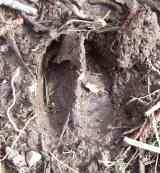
The size of a deer track will help you to determine the size of the deer. As a deer grows, their feet will grow accordingly. Big mature bucks will leave big and deep tracks. In soft ground the dewclaws will show on both bucks and does. Rounded tips on hoofs are a result of hoof wear usually due to rocky or other abrasive surfaces and have little to do with weather the deer is a buck or a doe.

When a deer walks, they will place their back hoof in the track of their front hoof. If the second track falls slightly to the outside of the first, it is probably a doe because a doe's hindquarters are wider than her chest. The wider hindquarters of a doe are required for giving birth. If the second track falls slightly to the inside and short of the first track, then it is probably a buck track since a buck's chest is wider than his hindquarters and his body is longer.

Deer Trails
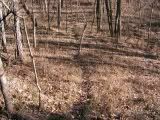
Think of deer trails like of our highway system. Deer trails are always coming from somewhere and going somewhere. Deer trails lead to food sources, water, bedding areas or connecting with other trails. Some trails can be as wide as a walkway while others are so faint that you can barely see them. Deer do not use all the trails at will whenever they want, there has to be a purpose for the deer to use any given trail. During the year deer use different trails at different times and for different purposes. To find out which trails the deer will use during different times in a hunting season and to plan hunting strategies that work the hunter has to find out which trails will be used by the deer at the time he hunts. What trails the deer will be using at any given time has to be determined by finding out what’s on either end of the trail or what they are connected to.

Deer Droppings
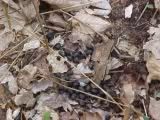
Deer droppings don’t tell me much, other than that at one time or other a deer walked here. There are only two incidents when I get exited about droppings. One is when I find fresh deer droppings plus other fresh sign that tells me that this is an active area full of deer that I need to hunt here right now. But as I said, there has to be other sign indicating that the deer are using the area, deer droppings alone don’t excite me at all. The second occasion is in the late season when I track deer in the snow with my bow or muzzleloader. Seeing fresh deer droppings, perhaps still steaming, puts me on high alert. This could mean that the deer is only a short distance ahead of me.

In future articles we will look a bit closer at different deer sign and how I use these signs to plan my hunting strategies.

If you have any questions or comments about this article please use the comment feature below.

Thursday, August 03, 2006

Making Sense about Deer Scents

© By Othmar Vohringer

Commercial Deer Scents
Two basic types of commercial scent are marketed: Attractant scents and masking scents. Attractant scents come in two varieties, sexual attractant scent and curiosity attractant scent.

Sexual attractant scents contain doe or buck urine interlaced with various glandular scents and hormones.

Curiosity attractant scents contain plain doe or buck urine. Others may contain different deer food scents. Such scents can be interlaced with urine and other scents such as vanilla, anisette, peanut and herbs. Although these scents are not a deer food their smell is pleasant to the deer and appeals to their natural curiosity.

Masking scents contain a wide variety of substances intended to cover up human odor. Most cover scents imitate the smell of deer and food sources or other animals such as coyote, skunk and raccoon.

The value of the scents is a controversial topic. There have been no scientific studies to prove or disprove the merit of scents, but many accomplished hunters will attest to their effectiveness. However using scent to attract deer is not a strategy that will work by itself but is rather on small part of a hunting strategy. In order for scent attractant to work it has to be applied where deer are traveling at the time the hunter intends to hunt a given area. No deer will make a long detour just to investigate a scent.

Deer Smells and Scents
Honed by the constant struggle for survival, the whitetail's senses of smell, sight and hearing presents a formidable challenge for hunters. In the day-to-day struggle to survive, the whitetail deer’s nose may be its best protection. Few animals have a better sense of smell than the whitetail. They can detect odors much better and from considerably longer distances than humans. A large portion of the whitetail's brain is devoted to odor reception and interpretation, and its nasal chamber can concentrate odors so they're more identifiable. A deers sense of smell is directional, meaning a deer cannot only identify the source of the smell but also the approximate distance and direction the smell comes from. It is assumed by scientists that a deer even can tell how long ago a deer has urinated just by smelling the urine.

Scents in Nature
Weather conditions affect how well deer detect scents. Steady breezes carry odors long distances, especially in flat, open country. Gusty winds disperse odors, making it hard for deer to locate the source. Dead calm conditions limit the distance at which they can detect intruders. Warming and cooling air can move scents toward or away from deer. In the morning, warming air carries scent uphill. In the evening, cooling air carries it downhill. Humid conditions, including a light drizzle, greatly improve a deer's ability to smell, but heavy rain washes odors from the air. And it's usually harder for deer to detect the odor of a hunter above the ground than one at ground level.

How to Use Deer Scents?
When using deer scent, you don’t want to confuse it but give the nose what it expects. Whether you’re after a buck or a doe, the right scent at the right time can put more animals in your shooting lane. Many hunters don’t clearly understand how to use deer scent and often have disappointing experience when using scents. They must realize that using sexual-based scents too early will chase away does and bucks. The whole idea of using deer scents is to bring deer towards your stand. The use of scents should help you position a deer so to allow you to draw the bow, and make a good shot. Scents can really help, but you have to learn to use the right scent at the right time. Besides using the wrong scent at the wrong time of the season is a fact that many hunters use too much scent. Read the label on the bottle and if it says, two drops then don’t empty the content of the bottle in one place. Too much scent will spook deer away. Deer know what they smell like at what time of the season and they also know how strong the smell is. Therefore deer know perfectly well that is very wrong when they smell another deer that by smell appears to be the size of and elephant..

How to Choose the Right Deer Scent?
Doe-in-heat urine is most effective during the actual rut but can actually hurt your chances of scoring if used too early in the season. Why? For one thing, you want does to come your direction while you’re hunting. Bucks are often nearby, often slipping along secondary trails, paralleling the doe’s movements. If a herd of does pick up the scent of a doe in heat they will vacate the area. Does that are not in heat learn to avoid the rutting bucks.

Buck-in-Rut Scents
Except for the brief period of the rutting season when whitetail bucks are actively seeking does big bucks are very reclusive animals. Things change quite a bit once testosterone starts to flow in them. However, bucks in your hunting area won’t magically go into rut just because you pour a few drops of doe-in-heat scent on the forest floor. Of course, you might get lucky, and a buck that’s not rutting might react positively to a scent. But more often than not, even the most dominant buck won’t get his buttons pushed by the scent of a doe in heat, until his instincts tell him the time is right. Again, influencing deer movement with scents is all about using the right scent at the right time. When that right time is will be revealed to you by observing deer behavior in your hunting area. Are the bucks still together in a bachelor group? Have they started to separate and fight with each other? Have the bucks started to follow the does around? Answer these questions and you will know what scent to use.

Scent For The Early Hunting Season
During the early season (roughly from September through early October in most parts of North America), hunters should play to the whitetail’s most basic instincts: Security, curiosity, and hunger. General deer attractants are what you want to use. The same applies to food-based scent as to sexual attractants. If the deer know that there are no other deer the size of and elephant then they also know that there are no acorns the size of watermelons. The same holds true for food scent. Using apple scent where there isn’t an apple tree around for miles defeats the purpose and will scare the deer away. Also there are no cornfields in the middle of a pine forest. Use food scents where the food you mimic exists and at the time it is available to the deer. For example use corn scent in and around cornfields and when the corn is ripe.

Personally I do not and never have used food attractant scent. My point is this. A particular food is either available to the deer or it is not and if it is then what’s the point in using that food scent. On the other hand if that food is not available to the deer then it pretty much is useless to fake the existence of the food with scent. Some hunters use food scent as cover scent. Personally I do not want to smell like an apple or a corncob and risk that a deer detects me. Besides apple don’t grow in pine trees and neither does corn.

Examples of How to Use Scents Properly
General scent attractants can be used to not only bring a deer in close, but to position it for the optimum shot! Here’s how to do it. We’ll use one example, and you’ll see how to adapt it to any type of terrain. Let’s say you know of a thick holding area (the classic in many areas is the wooded swamp or thicket) near a good feeding area (like a corn or other crop field). You know the deer travel back and forth between the two areas, but in scouting, you might find 5-8 different trails they use at different times. Obviously, you can’t be sitting on every trail at the same time. So you might pick a stand location somewhere in the middle, and lay down a scent trail that will help funnel deer right past you, no matter which trail they start out on. You’ll use a footpad or drag rag (both are available from sporting goods stores or you can make them easy yourself).

First, slip quietly down toward the swamp or thicket from the open area. Notice which way the wind is blowing, so you can bring the deer to you on the upwind side. Begin at one end of the thick cover. Apply the scent to the pad or drag rag, and lay down a scent trail that cuts across the various deer trails and angles up, out of the cover, to the upwind side of you stand. Add scent to the footpad or drag rag occasionally, increasing the amount, as you get closer to your stand. Go over to the other side of the thick cover and do the same thing. Now, you have two scent trails, both of which cut across a number of deer trails leading out of the swamp or thicket toward the food source. Your scent trails are set so that you will be sitting downwind of any deer that follows them. You have increased your chances of steering deer in your direction dramatically. To finish setting the trail, squirt a concentration of the scent onto a tree or brush about four feet of the ground. This scent station will stop the deer and position them for a good shot. Pick a spot that, should the deer pause to sniff on the scent station, will be in a clear shooting lane and broadside from you.

Tags: , ,

Page copy protected against web site content infringement by Copyscape
Related Posts Plugin for WordPress, Blogger...