Saturday, September 29, 2007

Must Reads For Every Serious Deer Hunter

© By Othmar Vohringer

It’s deer hunting season in some states and by October 1st in most other states hunters will venture into the woods full of anticipation too. Many hunters head to the woods each year not quite knowing how to improve their hunting success this year, while for others it will be their first hunting season ever. What ever the case may be here are two books I discovered, in the last minute before the season starts, that are a must read for every deer hunter looking to improve his or her hunting success this year.

Hunting The First State
A Guide to Delaware Hunting
By Steven Kendus
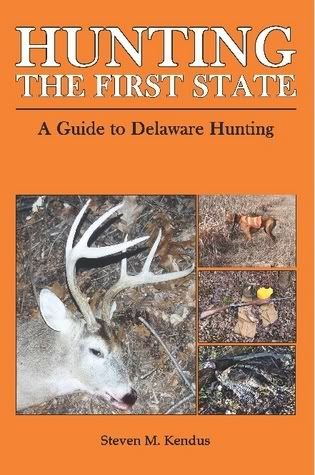
Perfectly situated on the eastern seaboard between the Chesapeake Bay to the west and the Delaware River, Delaware Bay, and Atlantic Ocean to the east, Delaware has proven to be a hunting paradise for local sportsmen. For centuries, outdoorsmen and outdoorswomen have harvested the natural riches offered by the wild game that inhabit Delaware’s deciduous forests, salt and freshwater marshes, and cultivated crop fields. Common game, such as white-tailed deer, Canada geese, and varied species of ducks have been targeted by the majority of Delaware hunters, but woodcock, quail, snow geese, crows, squirrels, and rabbits are also plentiful in Delaware and provide Delaware sportsmen with hours of hunting enjoyment each season. Join Delawarean Steven Kendus as he uses his hunting wisdom, experience, and research to preserve Delaware’s hunting legacy by sharing important history, tactics, locations, tips, and tricks associated with Delaware hunting.

Hunting the First State: A Guide to Delaware Hunting is the only book that comprehensively addresses hunting Delaware!

What's more, Hunting the First State includes useful hunting information that also applies to hunting in other areas of the Mid-Atlantic region, including:

  • Southeastern Pennsylvania
  • Southern New Jersey
  • Eastern Maryland
Hunting the First State: A Guide to Delaware Hunting is a must have reference for any hunter who hunts or who is considering hunting the Delaware region.
Find practical tips, tactics, and Delaware hunting locations for:

  • White-tailed Deer
  • Eastern Wild Turkeys
  • Eastern Gray Squirrels
  • Eastern Cottontail Rabbits
  • Bobwhite Quail
  • Mourning Doves
  • Woodcock
  • Crows
  • Ducks
  • Canada Geese
  • Snow Geese
Although the book deals mainly with hunting in Delaware, Southeastern Pennsylvania, Southern New Jersey and Eastern Maryland, knowing what an accomplished hunter Steven Kendus is I am sure some of his tips and tricks apply to other regions too.
To read more about the book or to purchase the book visit Hunting the First State

Mapping Trophy Bucks
Using Topographic Maps to Find Deer
By Brad Herndon
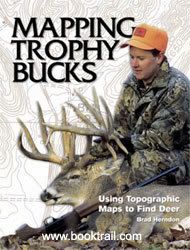
I have often said in my deer hunting seminars, and will keep saying it until the day I die, that the key to successful deer hunting is studying and knowing the structure of the land. This is especially so on hard hunted public land. Deer travel from fod source to bedding - or to escape hunting pressure – by utilizing the lay of the land and so do the trophy bucks when they chase does.

When Marc on his excellent blog NYbowhunter posted a review of Mapping Trophy Books I was very pleased to learn that finally a book has arrived on the market that I consider essential reading for every hunter regardless of skill level. Knowing how to use a topographic map and knowing the structure of the land and how deer use that structure will make scouting for that elusive trophy buck, or any deer for that matter, a snap. On 192 pages of Mapping Trophy Bucks author Brad Herndon teaches you how to use topographical maps and wind directions to pinpoint deer travel routes and to place your stands in advance of the deer season. This is likely the best $24.95 a hunter ever will spend.


To read more about the book go here. To read more or purchase the book go here

If you’re interested to learn more about my hunting seminars and clinics schedule, for more information or booking queries contact me.


Tags: , , , , ,

Page copy protected against web site content infringement by Copyscape

Wednesday, September 26, 2007

Are you ready for early bow hunting season?

© By Othmar Vohringer

The email said, “…Where do I look for deer food sources? Everything is green and deer seem to be everywhere eating whatever is available…”
This and similar questions are familiar to me; many hunters seem to be puzzled in the early season on the subject of deer food. Then there are the other hunters who simply say: “I hunt cornfields”.

In this article I try to shed some light on proper bow hunting scouting for the early season. As the email noted, in the early season deer have plenty of food available to them. In fact, the early season may very well be the toughest time to kill a deer unless you know what the preferred food sources are. Deer are a little like you and me in that they like variety in their diet but not all their favorite food is available to them at the same time of the season.

Corn and other agricultural crops can definitely be considered a favorite food source. Deer spend a lot of time in the crop fields but they do not spend all their time in these places. Crop fields are large places and a deer could be anywhere within one. This makes it very hard, if not downright impossible to hunt deer from a stand placed on the edge of a field. Remember we’re talking about bow hunting here which is very different from sitting over a field with a rifle. In order to kill a deer with a bow in the early season we have to find a place that gets us close to the deer. Also, if you hunt on public land - as most hunters do - every hunter in the country will be lined up along the cornfields.

The answer to this problem is what I call woodland food sources. What are woodland food sources? Deer frequently eat acorns, persimmon, honeysuckle plus many other plants. Our early season scouting should be concentrated on these food sources and not on the agricultural fields. Cornfields are only important in the early season scouting as a point of reference if you will. From there we have to find out how the deer travel to a particular woodland food source.

How do we find out what the preferred woodland food source is? It’s simple really. Whenever I scout a new area my first quest is to find out what the deer in that area eat besides agricultural crop foods. Deer diet varies not only from state to state but can vary from one area to the next. For example, the county in Illinois where I used to hunt, whitetail deer wouldn’t touch red oak, yet a few counties further away they would eat them. Here in British Columbia we have only a few oaks and the deer blissfully ignore them, but they go ‘nuts’ about wild blueberries!

Putting it together:
Find the agricultural fields and then find the preferred woodland food source of the deer in your area and find out when that food will be available to the deer. It is important that you check up on these food sources. It does your hunting success no good to sit over a trail leading to an oak ridge if the acorns are still on the tree.

From there you have to figure out how the deer get from the crop field to that woodland food source using your knowledge of the land structure. Don’t set up a stand right at the woodland food source. You can’t kill a deer at the food source. The best place to set up your stand is somewhere between the crop field and the woodland food source - the further back from the field the better - provided you do not get to close to the other food source. The best place for your stand is a funnel where deer travel is constricted to a narrow trail, or where several trails merge into one leading to the woodland food source. If you use this strategy it will get you away from the other hunters and it will be a productive stand that will produce deer for as long as that food source is available.

In future articles I will cover early season scent attractant and calling tactics and in another article I will tell you how to hunt a large cornfield successfully with bow and arrow.

Here I leave you with a link to an article about early season bow hunting written by noted outdoor writer and master bow hunter John Sloan which covers this topic further.

Pre-season Scouting by John Sloan

Tags: , , , , , ,

Page copy protected against web site content infringement by Copyscape

Sunday, September 23, 2007

Corey’s First Buck

© By Othmar Vohringer

Corey has been fly fishing for many years and still does so today, but about two years ago he discovered hunting and that is where our path crossed. Corey and I meet at the HuntingBC Forum where he had a lot of questions, as many novice hunters does, about many aspects of hunting. We he really got my attention was just before the first ever British Columbia spring turkey hunting season. It seems he was fascinated with turkey hunting and accordingly had many questions about the subject. Patiently and to my best knowledge I gladly gave him the answers to all his questions. We even exchanged emails where I was able to give him more detailed information about scouting, locating, calling tactics and ambush set ups.

Despite my help Corey failed to kill a turkey but made good for it during the waterfowl season were he harvested several nice ducks. That was just the success he needed to get fully hocked on hunting. The following fall spring season he tried his luck again on the turkeys but due to wet and miserable weather the birds were just not moving and he came back without shooting a bird. Once again he made up for it the fall when he harvested a fat mule deer doe.

Last week Corey posted on the SHS Hunting Chat Forum. “Me and my little BLR rifle finally put down my first buck. Just a little 2x3 but I couldn't be happier.” Of course I sent Corey right away an email telling him how exited I am for him. We live just a couple of towns apart from each other and I promised him that in the next spring turkey season I will accompany him and try my hardest to call a nice tom into shooting range for him.

Many years ago I have made it my personal dedication to recruit, introduce, and guide young and novice hunters as part of my personal commitment in the preservation of our hunting heritage. Today, “Passing the Heritage On” is a integrated part of Othmar Vohringer SHS. Each time I hear about one of “my” hunters harvesting a game animal, and be it only something small like a rabbit or grouse, I get exited and feel pride. To me such success stories of young and new hunters means that our hunting heritage has a silver lining on the horizon for a bright and continuous future. If we all do our part in passing our heritage on as to many young and new hunters as we possibly can then the antis will have no chance to destroy our hunting heritage.


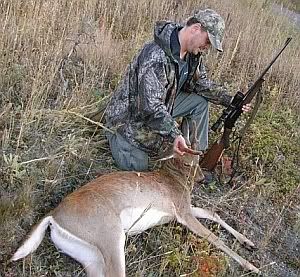
This is Corey with his first mule deer buck, a nice little 2 x 3.

Tags: , , , , , , ,


Page copy protected against web site content infringement by Copyscape
Related Posts Plugin for WordPress, Blogger...