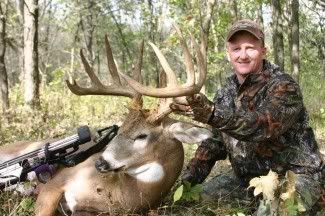
On October 28 I briefly reported about Casey Heine of Bever Dam, Wisconsin and how he got his 35 point archery monster buck in The First 2007 Monster Bucks. Today Casey sent me the story how he got that buck in his own words and you can read it here exclusively at Whitetail Deer Passion.
A Wisconsin Monster Buck As told by Casey Heine
I left school at UW Oshkosh at 2:50 p.m. and rushed home to hunt the evening of September 28. I finally got into the field at about 4:30 and decided to hunt a stand on the end of a fence line that connects to the marsh. There is a cornfield in front of me, a bean field in back of me, and the marsh to my left. It was a unseasonably warm afternoon and the mosquitoes were simply unbearable.
I continued to fight them off and at about 5:30 a doe and fawn came out into the bean field behind me at about 100 yards away. They ended up trotting across the bean field into the corn in front of me. At about 6:40 the same doe and fawn came out about 20 yards in front of me and walked toward the marsh. That’s when I heard a commotion in the bean field behind me. I looked behind me to my right and saw two deer running along the fence line toward me.
The 35 pointer was in front and there was a fork buck following him. I glanced at the head of the buck as he ran behind me and determined it was a "shooter." I had NO idea he was as big as he was. The bucks ran behind my stand and I pulled back as the big buck came around the fence line to my left. He was still running so I had to make a loud doe bleat with my mouth to get him to stop...Luckily the buck heard me and slammed the brakes on. He looked right at me and I took my time and placed the shot a couple of inches behind the front shoulder...The buck bolted after the shot and I watched him run along the marsh and field for about 75 yards where he made one huge leap into the marsh.
As he ran away I kept telling myself it was a good shot; however, when I looked on the ground where I hit him there was very little blood...I ultimately decided to wait until morning to make sure he had enough time to expire and I would have an easier time following the blood. I have had my share of kicking up wounded deer, and I did not want this to be one of those cases. I had a hard time sleeping that night! I went back out at about 6:45 a.m and discovered a fairly good blood trail. He started to really bleed good after about 30 yards. I followed it to where I saw him jump into the cattails and to my delight I saw a brown body laying there about 5 yards into the marsh. He must have just collapsed after the huge leap. I looked at his head and couldn't believe what I saw...Points everywhere! I probably scared everything out of the marsh when I made a scream of happiness! My first trophy buck was a 35-pointer!
Great story and great buck Casey. Congratulations on your trophy of a lifetime. The Othmar Vohringer Outdoors cap is in the mail to you.
Richard Burt from North Dakota sent this picture and story of his 2007 archery trophy to me and is the first recipient of a signature Othmar Vohringer Outdoors cap. Congratulations Richard on a very nice archery buck and to make it as the first in this small contest I am having here for my readers. I am looking forward to hear of more success stories from my readers. Keep it coming.
Story and Photo by Richard Burt
Well a storm came through last night, and it's about 15 degrees cooler this morning than it was yesterday, so I was hoping that might stir things up. Within 5 minutes of getting into a stand, a deer came by - it was still too dark to tell, but it excited me nonetheless. One more came through shortly after, and then came the sun...
10 minutes after sunrise, a spike came in and muddled around for about 5 minutes. Shortly after, came a pretty decent 4x4. Next, came my 2007 bow buck.
The nice 5x4 slowly trotted in from the north through the trees, stopped and went up on his hind legs to make a scrape. He started biting on branches, kicking the dirt under him, back to the branches, etc... for about 3 minutes. Finally, he turned away to get a different angle and I was able to draw. I held for about 30 seconds until he turned back broadside, and I let the arrow fly - WHACK - I knew I hit him good.
30 minutes later, I climbed down, found little blood, but could see antlers sticking up above the CRP grass west of the trees. I walked up to him, and found what might be my 2nd straight Pope & Young entry. I later measured him at about 129", after 60 days he'll be officially scored - I've got my fingers crossed.
The hunting season is still young and already we hear reports of the first big bucks that have been taken in the early bowhunting season.
The Daily Citizen reports of twenty-two year old Casey Heine who on September 28 arrowed a huge 35 point buck! Yes you read that right. The buck has 25 countable points! This may very well be an achievement that the young hunter never will repeat again in his lifetime.
Heine told the newspaper "The big buck came around the fence line to my left and ran along the marsh toward the doe and fawn," with a doe bleat Heine stopped the buck. With a well placed arrow behind the shoulder blade Casey but the buck on the ground. The scenario goes back exactly to what I keep saying. Fence lines, especially if they’re connecting two woodlots or coming from a woodlot into a marsh are always hotspots for big buck travel.
The second whitetail monster news comes from PJStar.com. Jeff Lampe writes in his Scattershooting Journal that Jay Gregory, host of the Wild Outdoors TV show which he presents for the past 15 years together with his wife Tammi, has killed a massive buck green scoring in the top 190’s. Jay Gregory has yet to name the state where he arrowed that awesome buck. Your guess on that one is as good as mine. Could it be Missouri, Iowa or Illinois? One thing is for certain that this is one nice looking deer. Gregory said that he soon will post a video of this hunt on his website.
These are two fine examples of early bowhunting bucks. Who said that you couldn’t kill a monster buck in the early season with a bow? Of course you can, you just have to be at the right time at the right spot and do everything just right, including scouting.
This has given me an idea. I would like to hear from you and your early 2007 archery season success. It does not have to be a monster buck. You’re the judge what a trophy is to you. Send a picture and short story to go with it to atacov@yahoo.ca and if I like it I will post it here on Whitetail Deer Passion for all to read. But that’s not all. The chosen picture and story will be rewarded with a embroidered and autographed SHS - Othmar Vohringer Outdoors cap. So lets get started and send those pictures and stories in to me.
Using deer scent and calls is still somewhat mysterious to some hunters. What scent should we use and when should we use a particular scent are just some of the questions I get. Then there are hunters that think that using scent and calling is a hunting strategy. It is not! Using scent and calls are tactics that should be used in a sound deer ambush strategy to make them work. Failure to realize this and it becomes utterly useless.
Then there are the skeptics that believe scent and calling does not work and is a waist of time and money. Is it? Depends. Deer attractant scent and calls can work great in positioning that elusive buck in front of your stand. On the other hand use a particular scent or call at the wrong time or over-do-it and it will scare the deer away into the next county.
To make scent and calls work it is imperative to know exactly the changing social behavior of the deer in your hunting area as the season progresses. For example, it totally defeats the purpose and actually will hurt your success in shooting a buck when you use a doe-in-estrus scent during the early part of the season when the actual rut is still a month or two away. The best way to know what the deer do in your hunting area is to study their behavior patterns and then adjust you scent and call tactics accordingly.
Early Season
Mid September and in some areas up to the middle of October the bucks are still in velvet and some does are still nursing or weaning fawns. This is the time to appeal to a whitetail’s sense of curiosity and appetite. Eyeing up or chasing does is the furthest thing from a buck’s mind. At this time of year the bucks still travel in bachelor groups.
Scent:
The scents that can work well at this time are food based attractant scents and plain doe or buck urine based scents. Other scents are curiosity scents that also can work very well. A curiosity scent is not based on a particular food source. These are scents that appeal to a whitetail’s curiosity; the smell is simply attractive to deer. Some of these curiosity smells are peanut butter, vanilla and anisette. There are commercial scents available mixed with plain deer urine containing vanilla and or anisette.
Calling:
Deer are quite social and will communicate with each other by using different sounds and behavior patterns. The calls that work best in the early season are plain doe and buck grunts. A social grunt is the equivalent to us saying Hello or how are you? This is a very easy call to reproduce with any deer call usually consisting of three to four soft “uuurrrrp – uuurrrp – uuurrrp”. A lot has been said and written about early season fawn bleats and if used correctly they can work as well to bring a doe or a curious buck into shooting range. There are two basic fawn calls and only one of them is worth trying in my opinion. That call would be a normal fawn bleat sounding like a youngster looking for its mama. It’s a call that a fawn will often make during the time when the doe weans it . On the other hand, the much discussed and promoted fawn-in-distress bleat is not a call that I would consider even remotely useful. A fawn in mortal danger will make a blood-curdling cry for help. Since deer have no actual defense possibility all they can do is rush to the scene and run in a mad dash around and around in an attempt to confuse a predator and lure it away from the fawn. With deer running like mad everywhere there is no way to get a clean shot at any of them, so I do not recommend a fawn-in-distress call as a valued call to attract a whitetail to your stand location.
Pre-Rut
As it get cooler and the nights longer the bucks start to get antsy and agitated. The joke Mother Nature plays on the bucks is that they are ready for business long before the females will be. In frustration they start to trash bushes with their now velvet-shed and hardened antlers. The bucks become progressively more intolerant of each other and engage in sparing matches. Small rubs start to appear on trees and saplings here and there. Often we can even see some haphazard scraping activity and these signs are indications of bigger things to come in the next few weeks.
Scent:
As tempted as you may feel to use a doe-in-heat or a buck-in-rut deer lure, keep it in storage, it’s not the time yet. During the pre-rut I still use the same scents as in the early season. What changes is my calling tactics.
Calling:
Now is the time to add some variety in your calling and to add some light antler clicking. The pre-rut is the perfect time to imitate sparing bucks. Mix your calling to make it sound realistic. When bucks fight they don’t just stay motionless in one spot and bang the antlers together. As bucks engage in a little sparing to get rid of their frustration, they first circle around each other and make grunting sounds. Sometimes they stomp the ground with their front feet and eventually they will engage the antlers by clicking them gently together. This is usually followed by a little pushing and shoving.
It is these sounds that I try to duplicate by giving a few soft buck grunts with my call while rustling the leaves with my feet or scraping the rattling antlers over tree bark if I am in a tree stand. My rattling sessions start by grinding and clicking the antlers gently together. I may continue with a calling session for about four to five minutes. If nothing happens I will repeat another calling session a half hour later.
Rut:
It is November and the bucks now actively begin to chase the does around in anticipation of the first females coming into the estrus cycle any day now. The does are not quite ready yet and actually try to evade the bucks while the boys get even more agitated than they already are. Now the bucks actively start to freshen up old scrapes and rubs, eating become less of a priority at this time of year as the interest in the opposite sex starts to take over a buck’s brain and they become very aggressive toward each other. The bachelor groups are dissolved, as each buck becomes a solitary wanderer perhaps permitting a young buck to follow him around on his quest to pass his genes on to as many does as possible.
Scent:
As the behavior of the bucks change so do our scent tactics. Now I pull out all the stops by applying doe-in-estrus and buck-in-rut urine and glandular lures to spike scrapes and create scent trails leading to my stand site. There are many different ways scent can be applied and I will write about that in a later article. The aim of my scent tactic is to attract a buck to me believing that he is following a female in heat or that he has to investigate an intruding buck.
Calling:
During the rut doe-in-estrus bleats mixed with antler rattling have worked very well for me in the past. With this tactic I give a passing by buck the impression that two bucks fight over an estrus doe and that this might be a good chance to snatch that doe away from the other bucks. Mimicking a strange buck with a buck grunt or two can be a highly effective way to coax a buck into shooting range too.
This rut scent and calling tactic will work all the way through to the end of the hunting season.
Conclusion:
Deer calls and scent can work great if used correctly and not viewed as do-it-all tactics. For scent and calls to work everything else has to be right too. The best results can be expected if the area is scouted and the stand locations are chosen properly. Deer will not make huge detours just to investigate a call or scent and by that I mean the best results can be expected if scent and call tactics are used where the deer are in close proximity.
Here are a few links to game call and scent companies that offer the products that I have used for many years and found to be useful.
“There are no bucks on public land worth hunting.” This is an expression that I hear many times when the talk is about hunting on public land. Others have said: “You can’t have a quality hunt on public land, there are to many hunters.”
Yes, hunting on public land can be tough, frustrating or downright humiliating. You also have to share the woods with other hunters and at times it seems that there are more hunters in the woods than deer especially on opening day. But make no mistake about it, there are bucks on public land, even big bucks. Compared to public land hunting deer on your own private honey hole is like shooting fish in a barrel.
All hope is not lost. With a little thinking and a change of hunting strategy you too can drag out a good buck to your truck from public land. To become successful we have to forget every advice on hunting strategies we have read in magazines or seen on TV because public land deer are a very different breed from the deer on private land- as in ‘smarter’. These critters have seen it all, especially the mature bucks that survived two or three years of intense hunting pressure.
The key to success is scouting. Scouting on public land is also different from scouting on private land. When I scout on public land I don’t worry about finding deer sign such as rubs and scrapes. I am scouting for hunter activity. I want to know what the other hunters did and where they went. The best and most productive time to scout is right after the hunting season closes. You may ask “why scout after the hunting season and what good will that do me for the fall/winter season next year?” Well, the post-season scouting has four advantages over any other times.
1.) In the winter you can see the structure of the land very clearly before you. Where you couldn’t see 20 yards in the fall now you can see for a long way. It is easy to distinguish the different terrain structures, edges and travel routes of the deer from the landscape. 2.) Right after the hunting season you still can see the sign other hunters left behind, such as tree stands, trails and the red flagging tape with which they marked the way from the truck to the stand sites. 3.) The deer still will have the movement patterns they had during the hunting season. It takes deer about two to four weeks before they go back to normal (un-pressured) behavior. 4.) At this time of year you do not have to worry about spooking deer as you walk the trails to map out deer travel patterns and find the woodland food sources. The deer will not remember your intrusion come next hunting season.
What the scouting will reveal is that even on relatively small public land places there are what I call islands. These are places that hunters don’t go too. The reason for this is that either such islands are places where it is difficult to get too, (such as a steep ravine, flooded timber, dense undergrowth and so on) or it is simply to far away from the truck. Studies have shown that the average hunter never ventures much further than a quarter to a half a mile away from the vehicle. There is something else the average hunter avoids like the plague and this is the proximity of houses, streets and open areas. For some strange reason many hunters think that deer live in the timber or they set up along agricultural crop fields that border onto timer.
Deer know about the habits of hunters and react to it by going to places that hunters overlook or find uncomfortable. Would you sit in a wide-open field behind a lonely apple tree watching a patch of tall grass not larger than a pick-up-truck? Or how about crawling on your hands and knees through a thorn-spiked thicket right next to the parking lot? One of these, the thicket, is where I shot my first public land deer, a big 8-point buck. Sitting behind the apple tree in the open field overlooking a tall grass patch I have seen a true monster buck that surely would have made the book but he never presented me with a perfect shot opportunity and so I had to let him walk.
Ever since then I am an advocate for public land hunting. I like the special challenge in outwitting other hunters and pursuing ‘hunter smart’ deer. But just as important, if not more so, is the fact that public land is easily accessible and affordable for all income brackets. The most important factor is that the upkeep and managing of public land is mainly financed by hunter’s dollars. Once this money dries up the government would have to sell off most of the land to developers. Loosing these lands would not only be a great loss for hunters but for everybody else too.
To that end I leave you with a video from Jadon Duncan, a young hunter who hunts and videotapes mainly on public land. It is worth a visit to his website where you will see many more videos of big bucks that he hunted and filmed on public land.
Pay particular attention to one segment in the video where it gets very noisy in the background. As the camera swings over to the direction where the sound is coming from Jadon explains that he is right next to an auction lot. This proximity to human activity does not seem to bother the huge buck he shoots a few minutes later but it sure would bother the average hunter to set up at a place like that. The more videos I watched of Jadon Duncan the more I felt proud of him and his achievements on public land. He is a smart guy and that is not only because he uses a TreeLounge climbing stand, the safest tree stand in the world. He is one heck of a young hunter too.
Marc from the Nybowhunter.com is another smart public land bowhunter that regularly scores on nice bucks. In a recent article Scouting Public Land he explains how he found a deer sanctuary: here is a quote from the article that explains perfectly what I have been talking about regarding the hunter-free islands on public land:
“…I found a few deer trails and one that led into a swamp. However, for me, these were spots that although they could hold deer, I'm sure everyone would hunt. The saddle was up a steep mountain and was covered in huckleberry and mountain laurel. It was a lot thicker than I imagined a saddle to be, but nonetheless there were more deer trails and a few more buck rubs. Another promising aspect of the area was the abundance of acorns, giving the deer yet another reason to travel through this area.”
* * *
Here is a Smart Hunting Strategies tip that will work every time on public land and puts you well ahead of every other hunter. Find the agricultural fields or other main food sources. From there find the trails (escape routes) that the deer use to evade the hunters that will lead to the sanctuary. Once you figured that out all you have to do is set up a stand in a location that gives the best opportunity to get a good shot at the deer and stay undetected. It is not wise to set up right in the sanctuary as this could cause the deer to vacate to another place and you would have to scout from scratch. Once the already paranoid deer are aware of your invasion into their sanctuary it could be next to impossible to find the deer again.
So there you have it. Public land is not as bad as the reputation it has. Next time you go out to your favorite public land spot look for these hunter unfriendly places and check there for deer sign and I bet you will be pleasantly surprised. The name of the game on public land is to outsmart the other hunters. Do that and you too will shoot a buck that nobody knew even existed in that place. It can be done!
Two weeks ago I started a poll on this blog asking the readers “Where Do You Hunt?” So far 19 visitors have participated in this poll but there is a clear trend. Despite all the hardship and difficulty it provides public land is still ranking high on number one. To me this is not really surprising. Public Land is readily accessible for every hunter. Unless someone lives in Texas and one or two other states, there is public land for hunting available within one or two hours drive for everyone.
Unlike any other options, such as hunting leases, public land is very affordable for all income groups. I have always been a defender of public hunting land because I believe that it is important that we take the opportunity to hunt on these places. The simple fact is if it were not for the hunters that make use of public land the government would soon run out of money to keep the management up and the land open for the public.
Polls like this are not only fun to do. They are also an indicator for me to see what the readers of this blog do. In the future I will provide more tips and field proven strategies that have helped me to be successful in killing a deer on public land.
Here are the results from the poll. Thank you to everyone that participated and please keep the votes coming.
Public Land 42% (8 votes) Private Land 32% (6 votes) Leased Land 11% (2 votes) My Own Property 11% (2 votes) Hunting Club Property 5% (1 votes)
Law enforcement officials in Illinois have proposed regulations that will prohibit young people from partaking in hunting and other firearm-related activities. The Illinois State Police (ISP) has submitted a proposal to the Joint Committee on Administrative Rules (JCAR) that will prohibit anyone under 10 years of age from obtaining an Firearm Owners Identification Card (FOID). All Illinois residents who buy or possess firearms are required to have a valid FOID card. The proposal appears to be the department’s knee-jerk reaction to anti-hunting/anti-gun activists who responded with hysterics after reading a satirical article that made light of how easily a newborn could obtain a FOID. The ISP’s proposal has drawn the ire of sportsmen. It denies parents of the right to decide when and how children get involved in hunting and shooting sports. If the age restriction is put in place, it will delay the entry of successive generations into the hunting heritage and lead to a decline in the sportsmen’s community. “Research shows that in states with hunting age restrictions, the recruitment and retention ratio of new hunters is lower than in states that do not have such restrictions,” said Bud Pidgeon, USSA president. “At present, Illinois does not have a minimum hunting age, and we would like to see it stay that way.” The JCAR is an administrative body responsible for reviewing and considering proposed regulations. Prior to considering proposed regulations, JCAR must observe a 45-day public comment period during which citizens may submit written comments. USSA will submit official comments to JCAR early next week. Illinois sportsmen should keep an eye to your e-mail for an action alert.
Frankfort, Ky. – No changes are anticipated this year to Kentucky’s deer seasons or zones due to the widespread outbreak of Epizootic Hemorrhagic Disease (EHD).
Officials with the Kentucky Department of Fish and Wildlife Resources have documented 3,000 deer deaths this year due to an outbreak of the disease. That number is only a fraction of Kentucky’s estimated deer herd of nearly one million.
“It’s only affected a small percentage of deer, so we’re not planning to change any seasons or zones this year,” said Wildlife Division Director Karen Alexy. ”There are still plenty of deer out there, and the first hard freeze should help stop the outbreak.”
A virus transmitted by the bite of a midge (gnat) causes hemorrhagic disease. Hard freezes should stop major outbreaks because the cold kills the midges. The virus is not infectious to humans and cannot be spread from the carcass of a deer.
The disease outbreak first flared in western Kentucky before progressing to a majority of counties in the state. Residents of northern and eastern Kentucky are now reporting an increasing number of deer deaths as the disease spreads. Officials in several surrounding states report similar outbreaks.
Kentucky’s outbreak is causing concern among hunters because of the visibility of dead animals. A majority of the carcasses are being found around water, where they are easily seen. This has led to a high number of calls to Kentucky Fish and Wildlife about the outbreak and whether deer seasons or zones will be affected this year.
Tina Brunjes, big game coordinator for Kentucky Fish and Wildlife, points to the number of deer taken by archers this year as evidence that the disease is not having a large enough impact to affect hunting seasons or zones. The number of deer taken by archers during September was about the same as last year, which itself was a record year for deer harvest during that month.
“Deer harvest totals to date are about the same as they’ve been for the past three years,” she said. “If this disease was eliminating entire deer herds, then bow hunters wouldn’t be so successful.”
Kentucky has so many deer that it is not necessary to avoid harvesting does, especially in Zone 1 and Zone 2 counties, where the deer concentrations range up to 63 animals per square mile.
Department officials will reevaluate herd numbers once the outbreak ceases. This year’s drought and spotty production of the state’s white oak acorns and other nut crops may affect the number of deer that survive the winter. Department officials will evaluate total deer numbers and recommend any changes to zones in 2008, if needed, at the March meeting of the Kentucky Fish and Wildlife Commission.
In the meantime, hunters should not be deterred by the outbreak. Eating the meat of deer that appear to be healthy poses no risk to humans even if the deer is infected with hemorrhagic disease.
However, hunters should not consume animals that appear emaciated or weak prior to harvest, due to the risk of secondary infections. Hemorrhagic disease can cause large abscesses to form in the body cavity, muscle tissue or under the skin. These abscesses render the meat inedible.

I left school at UW Oshkosh at 2:50 p.m. and rushed home to hunt the evening of September 28. I finally got into the field at about 4:30 and decided to hunt a stand on the end of a fence line that connects to the marsh. There is a cornfield in front of me, a bean field in back of me, and the marsh to my left. It was a unseasonably warm afternoon and the mosquitoes were simply unbearable.