Sunday, August 31, 2008

Calls and scent for early deer hunting season

© By Othmar Vohringer

Here is a question that I get quite often asked from hunters. ‘What are the best calls and scents to use in the early deer hunting season?”

Let me begin by saying that the solid foundation of all hunting success is smart scouting and stand placement according the scouting results. All the tactics, what ever they may be, you use will do nothing for you without scouting first.

It always has been my opinion that the early season is without a doubt the toughest time to kill a mature buck, if that’s what you’re after. I have however, arrowed many deer in the early archery season. All of them were does and small bucks. This is not to say that it is impossible to kill large bucks too. One look in the trophy books will prove that a fair number of record bucks are taken in the early season.

The reasons the early season is so hard on deer hunters bent on shooting a large buck are that the odds are overwhelmingly in the favor of the deer. For starters, the vegetation is still thick, providing plenty of cover for deer to travel. Food is available practically everywhere right in front of a deers nose and the still warm daytime temperatures causes deer, especially the big bucks, to travel predominantly before and after legal shooting light.

This brings me to the original question of what calls and scent to use in the early season. Personally I am not big on using calls and scent in the early season at all. The bucks at this time of year still travel in bachelor groups and still have their antlers in velvet. This means rattling antlers and other buck calls that can attract bucks during any other time of the season are out of question.

If I would use a call in the early season it would be no more than a few friendly social deer grunts, and only if I see a deer and only if the deer is out of shooting range. So what about deer scent then? Well, in my experience it’s very much the same deal as with calling. The rut is still far off in the future. This makes the use of doe-in-heat or buck-in-rut scent pretty much useless. In fact if you were to use these scents you would likely scare deer away because it is not natural for that time of year. That basically leaves me with only one choice, which is to use regular doe or buck urine.

But what about food based scents. Will they work? To be truthful with you I have never seen much sense I using food based attractant scents at any time during the hunting season. If I am hunting near a cornfield then the air is saturated with corn scent. If I am in an apple orchard the air is saturated with apple scent. So what’s the point in adding more of the same scent? If my stand were located away from cornfield or apple orchard it would be pointless to use corn or apple scent in fact by using such scent I would let the deer know that something is not right here.

Deer are intricately familiar with their surrounding. In other words deer know exactly what food grows where and at what time of year it is available to them. Trying to bluff a deer into thinking that a particular food is available when it is not is a sure recipe of raising a red flag.

Because of all these limitations I do not use any scent in the early season and only call when I see a deer in the distance in the hope to coax it within shooting distance of my stand. Sometimes this works and most times deer blissfully ignore it.

Conclusion: While the right scent at the right time and palce or, and calling used cautiously can work sometimes it is not something I would consider using in the early season. Proper scouting and keeping taps on deer movement patterns and placing stands accordingly are a much better guarantee to get close to an early season buck.

Other related articles to this topic you may find of interest:
Deer scent and calling tactics through the seasons
Making sense about deer scent
Outdoors with Othmar Vohringer
A year in a whitetail deer’s live

Tags: , , ,

Thursday, August 28, 2008

Hornady Introduces new slug for deer hunters

© By Othmar Vohringer

Right in time for the upcoming deer hunting season Hornady introduces the new SST™ Shotgun Slug. With this new slug long range accuracy from a shotgun slug has become obtainable.

There was a time when hunting deer with a shotgun slug meant that getting in close to the game was a must. Those days are over. Hornady’s NEW SST™ Shotgun Slug transforms your favourite rifled barrel slug gun into a weapon that will outperform some centerfire rifles.

Hornady’s NEW SST™ Shotgun Slug allows you to bring unheard of accuracy and terminal performance to slug-only areas. The super-accurate SST™ bullet delivers sub-2" groups at 100 yards; and the flattest trajectory on the market.
The polymer tip of Hornady’s field-proven SST™ help it slice through the air, minimizing drop and wind drift. And, when the bullet strikes its target, the tip initiates violent expansion, transferring its energy payload to the target, ensuring a swift kill.

This season, step up to Hornady’s NEW SST™ Shotgun Slug and revolutionize your slug hunting experience and success.

The specs for the new slug are as follows according to Hornady:
The slug is available in 12 gauge, 2-3/4" length with a 300 grain SST bullet .500".
Velocity at muzzle 2000fts. (1341fts. At 200 yards). Energy (ft/lbs) at the muzzle 2664 and still has left 1198 ft/lbs. At 200 yards. Trajectory: Zeroed in at 150 yards. -0.9” at the muzzle, +2.4” at 50 yards, +2.7” at 100 yards, 0.0” at 150 yards and -6.7” at 200 yards.

For more information visit the Hornady Website.

I am looking forward to put this new slug through its paces in my Savage Model 210F Slug Warrior, given that this gun is a specialized centerfire rifle like slug gun I expect the new Hornardy SST™ slug to perform very well.

Tags: , ,,

Friday, August 22, 2008

Virginia bowhunters win

© By Othmar Vohringer

My good friend Peter Gussie of Midwest Cimmarron Archery in Richmond, Illinois, and board of directors member of the Archery Trade Association (ATA) sent me good news for bowhunters in Virginia that likely sets a nationwide precedence.

In mid-July the Virginia Supreme Court upheld a lower courts ruling that bowhunting is a safe science based wildlife management tool and that local communities cannot outlaw bowhunting programs that comply with directives from the wildlife agencies.

The Supreme Court, in choosing not to hear an appeal by the Reston Homeowners Association, also upheld a lower state court’s decision to allow the Archery Trade Association to recover all legal fees. After being alerted to the situation by the Suburban Bowhunters of Northern Virginia, the ATA brought legal action against the Reston Homeowners Association in January 2007. The ATA won the lawsuit in December 2007, and continued the fight after the homeowners’ association appealed to the Supreme Court in May of this year.

Due to the result of this court ruling bowhunters are able to return to the Roston’s woodlots this coming fall. Jay McAninch ATA President/CEO said.
“This is a huge victory for bowhunting, not only in Virginia, but quite likely nationwide. The Virginia Supreme Court reinforces four critical points that form the foundation of bowhunting in America.

  • First, bowhunting in urban areas can be done safely without putting people or property at risk.
  • Second, individual property owners can use bowhunting to address deer-damage and nuisance problems.
  • Third, wildlife is a public resource that’s held in trust and managed by states — in this case, the Virginia Department of Game and Inland Fisheries — for the public’s benefit.
  • And four, individuals or a homeowners’ associations cannot usurp state authority, or use the courts to shut down or interfere with a legitimate bowhunting program. When people or groups violate these historical, well-established lines of authority and take actions based on personal opinions, it’s going to cost them.”
The Supreme Court ruling has put an end to a long legal dispute that began in 2004 when Reston Homeowner’s Association adopted a covenant to shut down the suburban bowhunting program. The bowhunters of Northern Virginia and two local residents alerted the ATA in 2006 about the bowhunting ban. The ATA filed complaint in January of 2007. Arguing that the covenant violated, among other things, Virginia’s Constitution regarding wildlife management. Virginia’s attorney general refused to enter the case to enforce the agency’s wildlife management authority. Upon which the ATA subpoenaed testimony from the Department of Game and Inland Fisheries.

In December the local court ruled in favor of bowhuting and that the Homeowners Association did not have the authority to ban bowhunting. This ruling was uphels by the Virginia Supreme Court.

McAninch said.
“We’re extremely gratified to win a ruling of such high stature. This should set a strong precedent in Virginia and elsewhere. Virginia’s long-standing approach to urban deer depredation problems is to use bowhunting whenever possible. Bowhunters in Reston were part of that solution and had a proven track record. Unfortunately, the homeowners association went ahead and created their covenant even after they were advised they were exceeding their authority. The facts were against them from the start. Maybe now they’ve learned they can’t make laws just because they don’t like bowhunting. Just as importantly, when local groups force bowhunters to go to the courts to restore our rights, it’s going to cost them.”
I am extremely pleased with this outcome because it shows that we hunters do not have to put up with those that want to deny us our rights and freedoms. Hunting is not, as often falsely interpreted, a privilege. It is a right! One of the reasons why I like our North American hunting tradition is because, unlike anywhere else in the world, we have the right to hunt regardless of social, financial, racial or religious background. This is very unique and we need to protect that right so future generations can go hunting too. Hunters, as shown in this case, are not alone. There are many good organizations, such as the ATA, that will assist us in defending our rights from those that want to take it away from us.

Tags: , , , ,

Monday, August 18, 2008

Make that shot count

© By Othmar Vohringer

On Saturday a bowhunter from Ohio sent me an email in which he asks. "Where would you zero in on a deer? My stand is 15 feet high in a tree.” This is not much to go by to give a sound recommendation

There are two variables to consider, besides stand height, in estimating the aim point. How far from the stand is the deer? How fast is the bow you’re shooting?

Regardless of stand height and distance of the deer from the stand, I always recommend aiming low. There are two reasons for that suggestion. Shots that are taken from any height always impact higher than the same shot taken form the same level as the target. Second, if the deer jumps the string the impact will be higher again. It is a fact that most deer missed from treestands are missed high. Go figure.

How low you have to aim depends entirely on the speed of your bow and the distance from the target. The best way to learn where you have to aim is to practice with your bow from various stand height and target distances. Once you have established the difference you either can adjust your sight pins accordingly, or do as I do and commit the aim point to memory.

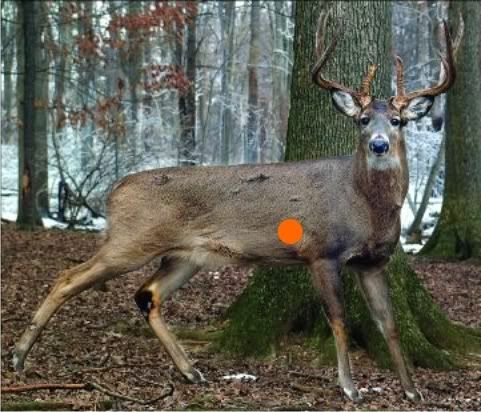
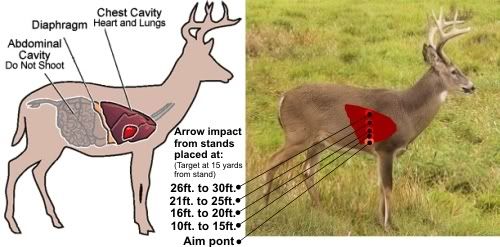
Here is a chart that I made up from data gathered from my treestand shooting practice. Mine is a moderate speed bow and as I said earlier, the impact varies with the speed of the bow and weight of the arrows.

Here is where I genearlly aim from my average stand height of 15ft and the deer at 15 to 25 yards from the stand.


And here is a chart of what my practise arrow(*) imapcts look like with the same point of aim but different stand heights. (Click image for larger view.)


Update:
(*) After an angry email from a non-hunter I might mention that “practice” arrows are not shot at life animals, as the email writer assumed from my post. It puzzels me how some people even would assume that hunters use life practice targets. All the shooting practice with the bow and establishing arrow flight pattern (trajectory) is done on targets and so called 3-D targets. 3-D targets a life sized targets resembling a deer or other game animal.


Tags: Tags: , Tags: , Tags:

Monday, August 04, 2008

Early Season Deer

© By Othmar Vohringer

Sweat dripping of off my eyebrows and earlobes I sat in my treestand on a humid warm early October morning. It will be another hot day. The only reason that kept me on stand was the assurance that my patience will be rewarded. At exactly 8am two does and a small buck walked under my treestand. A half hour later I loaded a fat doe into the back of my truck.

A few days later I watched six deer, among them two young bucks, passing not twenty feet past my stand, situated in a pine tree overlooking a narrow passage on a slope leading 100 yards belong me into a cornfield. Just before dark a lone older doe came along the same trail. She went less than 40 yards from where the Thuderhead tipped arrow passed through her. In both cases I sat less than two hours in my stand before the deer passed by.

I am not telling you all these to brag but to make a point. Scouting! Not just scouting but smart scouting was the reason for a freezer full of venison in both cases. My pre season scouting is based on post season scouting information. In the post-season scouting I find the four factors of deer movement, food, cover, terrain and structure. In addition I know what the deer in my hunting area all eat. And I don’t mean just the agricultural crop available to deer. I know what else the deer eat besides agricultural crop. I also know what food is available to deer at any given time during the hunting season.

Knowing what the deer eat and when that food is available to them, and how they use the terrain, cover and structure to travel lets me with certainty choose stand locations that will produce deer sightings. It’s that simple really.

The two stands mentioned at the beginning of this article have been placed long before the bowhunting season opened. Although at the time when I set the stands up there where no deer in that area. In fact my hunting partner even asked me if I am sure about the stands because he hasn't seen any deer at that location. I told him, “Trust me, come October opening day the deer will move in this area and use the trails where I placed the stands.”

Hunting the early season may be the toughest time of year to kill a big buck. The key to early season hunting is food. But food is everywhere at this time of year so how can we predict what the deer eat? The trick to unravel this mystery is to locate the preferred food sources. Regardless where you hunt there are certain foods deer prefer besides corn, beans and alfalfa. For lack of a better word, I call these preferred woodland food sources. It is your job to learn what these food sources are where you hunt and then figure out at what time during the season these foods are available to the deer.

When I lived in Illinois the deer loved to brows on honeysuckle and later when white oaks became available deer would prefer oaks to honeysuckle, changing travel patterns accordingly. Here in British Columbia we have no honeysuckle or white oak. Here the deer browse on blackberries that grow everywhere plus on various shrubs. Most of these plants I do not know by name but I do know what they look like and when they are available to the deer.

Figuring out the preferred food sources is just one part of the puzzle. There are other factors that you need to consider in your early season scouting. One of them is the availability of agricultural crops. Don’t assume that the cornfield from last year will be planted with corn again. Farmers rotate fields, last years cornfield may be a bean field this year. Make sure you know what the farmers plant. Food alone does not let you predict what route deer travel from the field to the preferred woodland food source.

Your next step is to figure out the path the deer take. If you did your post season scouting properly you know how food, terrain, cover and structure relate to each other permitting you to make a choice stand selection based on that knowledge and information. With that knowledge select as many different stand location as possible for the early season.


A fresh stand every day.

One of the mistakes some hunters make is to select one or two stand sites and then hunt them every day. I never hunt a stand more than once every seven days. it is a fact that the more you hunt a stand the less the chances are you will shoot a buck from that stand. I always try to have at least six or seven stand sites available. Some of these sites will have a hanging treestand while others are prepared for one of my climbing treestands. All my stands are set up at least ten weeks before deer hunting season opens, unless I hunt on public land where I can’t hang stands in advance. Once the stands are in place or the site is prepared for my climbing stand I NEVER will go near that location again until the day I hunt that stand.

On what day I hunt a particular stand has been pre-determined from the information and knowledge I gathered from my post and pre season scouting. All the stands will be in place long before the deer know that they are going to be there. I have done nothing to alert deer to my presence and I am going to keep it that way by hunting each day a different stand throughout the season. Even If I see a lot of deer from one stand without getting a shot at any of them I will not return the next day, I will rest the stand for seven days before I return do it.

Let other hunters do the work for you.

My very first early season public land buck has been pushed to me by other hunters. Once I figured out how to make hunting pressure work for me I am no longer afraid of the season opening day. On public land I do not worry about food sources instead I look more closely at the structure of the terrain and at cover. I also closely examine what the hunters did the previous year. I do this right after the hunting season closes. Given human nature the hunters will do more or less the same this year. Armed with this knowledge I start to look for routes the deer use to evade the hordes of other hunters.

Setting up on a narrow funnel, such as a saddle or fence crossing in a escape trail I just sit and wait. On escape route stand locations I arrive long before all the other hunters enter the woods and then just sit tight and wait for the action to start. Once the hunters move in the deer start to retreat. In the past I had up to forty deer passing by my escape route stands never realizing that I was there. Setting up on escape routes you will see big bucks that you never knew lived on public land.

I scout far more than I hunt because I believe that proper scouting is the actual hunt. If I do it right then all I have to do is show up on time and shoot a deer. Pre-season scouting is a simple matter of understanding the food source and then matching that foods source to the terrain, cover and structure to determine deer travel patterns. Done properly pre-season scouting is the key to smart stand selection and this in turn is the key to fill the freezer and hang antlers on the wall.

Related Articles:
Knowing the four factors of deer will improve your hunting success
Deer Hunting Tips
Cornfield Bucks
Deer Scent and Calling Tactics Through the Seasons

Tags: , ,
Related Posts Plugin for WordPress, Blogger...