Showing posts with label Bowhunting. Show all posts

Tuesday, June 02, 2015

The Factors That Make A Perfect Deer Hunting Stand

© By Othmar Vohringer

It’s already June again, and with that said it is time to think of the upcoming hunting season. This time around I start to think about treestand locations. The bow hunting season begins here on the first day of September and I always try to have all my stands up by late July.

I did all my preliminary scouting after the hunting season closed last year and fine tune it in the spring into early summer. With that said, I already know where to hang my treestands or build natural ground blinds. I am often asked. What are the factors of a perfect stand location?

Hunting deer with a firearm I can set up stands almost anywhere within the radius of active deer movement, provided I have clear shooting lanes. Where attention to detail in stand location and placement can break or make your hunting is during bowhunting season. In order to get close to deer and stay undetected we have to be very aware of every little detail in choosing stand locations and setting up stands. As often is the case the devil is in the details.

These are the factors that I consider imperative for a successful stand setup.

Scouting:
I am continually surprised how many hunters head to the woods a few weeks before deer season opens and hang a stand at the first tree next to a trail with fresh tracks. Doing this you jeopardize any hunting success and have to rely entirely on luck to fill your tag. A wise hunter once said; hunting success is the result of 80 percent scouting and 20 percent luck. If you do not scout, or scout incorrectly, your success is dependent entirely on luck. Over the years I wrote several magazine articles dedicated to scouting. I encourage you to read the linked articles below and apply the advice.

Scouting For Hunting Success
Mapping Out Deer Hunting Success

Enter and Exit Routes:
The best stand location is rendered useless if you can’t access or depart the location without alerting deer in the vicinity. And before you say “I don’t have to worry about deer detecting because I wear scent eliminating hunting garments and boots”. Let me tell you that deer WILL detect you coming or going if your bath to or from the stand crosses deer holding areas. Deer are perfectly attuned to everything that goes on around them. The best way to avoid letting deer on to your presence is choose entry and exit routes carefully. Depending on the stand location you may have to choose a different exit route from the one you enter the stand. Proper scouting will reveal what exit and access routes you have to choose.

Treestand Height and Cover:
A lot has been written and said about how high a treestand should be placed on a tree. There is still a considerable number of hunters believing that the higher you can go the better. This simply is not true. I told that story bevor but it is worth repeating. A few years ago on my walk to one of my stands I spotted a large black spot about 50 feet off the ground on a pine tree trunk from a distance of about 400 yards. Using by binoculars the large black spot turned out to be a hunter in a treestand. If I could see that dark spot high up on a tree trunk then so could the deer. It is a myth that hunting from a stand placed high up on a tree will prevent deer from smelling you. I covered that myth and other treestand placement mistakes in, “The most common mistakes when setting up treestands".

The height of the treestand is determined by the cover around you. As a bowhunter it is important to stay in cover as much as possible, to achieve that we have to make use of the natural cover around us. When I have chosen a tree for my stand I will check from the distance where I expect deer to approach my stand location at what height off the ground the best cover is available. By looking up the tree I can see where the background cover is to my satisfaction and that is the height were my stand will be placed, be that 8 feet or 20 feet off the ground. Neglect cover in placing your stand and you will be detected by deer. Treestands have given hunters, especially bowhunters, a huge advantage. The downside of treestands is that this popular hunting method has educated deer to look up to the treetops for danger.

Wind:
Wind is a constant consideration of mine in placing a treestand. I place stands in such a way that the prevailing wind carries my scent into an open space not frequented by deer or backed up against steep ravine, river, lake or other obstruction that deer avoid or can’t cross without passing by my stand first before they get a whiff of me.

Shooting Lanes:
As important as all the above is, you need shooting lanes. This can be a bit tricky at times. The trick is to cut enough shooting lanes that get at least two or three clear lanes to shoot at deer from every direction you expect deer to travel past your stand. You want to be very mindful of not overcutting shooting lanes to the point that you lose cover. Here it pays to know the trajectory of your arrows as they make their way to the target. Diligent target practice at different distances will make you familiar with your arrows fight path. Typically I trim shooting lanes at the very least a month or even two before hunting season opens.

Silence is Golden:
If you do everything right it will be no good if your stand pops and creaks every time you move. Silence is golden. To keep a stand quiet use a quality product and maintain it regularly. After each hunting season I check my stands for worn parts and lube all moving parts like platform and seat hinges with unscented lubricant paste. In addition I cover the treestand bow-holder with moleskin to prevent metal to metal sounds.

Comfort:
And finally, never underestimate comfort. An uncomfortable treestand, no matter how well it is placed, will end in misery. More than anything else uncomfortable tresstands are the result why hunters leave to early. You can improve the level of comfort by adding an extra cushion on the seat and as a backrest onto the tree trunk. Additional measures to improve comfort are cutting off and branch knots on the tree trunk to avoid being pocked in the back and adding a foot rest to standing platform. In short take whatever steps that is necessary to accommodate your level of comfort for many hours of sitting still.

In addition the tips provided here I would like to direct your attention to two articles relating to the topic covered here.

Choosing the right treestand for the perfect ambush
Treestand hunting essentials

Sunday, March 27, 2011

Whitetail Deer Bowhunting Seminar

© By Othmar Vohringer

If you live in or around Merritt, British Columbia and are a novice or advanced bowhunter make sure to attend this upcoming seminar. The seminar, held on four evenings in the Merritt Civic Centre, will teach you everything you need to know to become a successful bowhunter.


###

This column has been brought to you by Othmar Vohringer Outdoors

Tuesday, June 22, 2010

BC Outdoors Hunting & Shooting Magazine

© By Othmar Vohringer

The BC Outddors, Hunting & Shooting summer edition magazine is now available on the newsstands all over British Columbia. If you want to improve your early season bowhunting success you need to read my article, “The Four Factors of Deer Movement”. In the article I outline what the four factors are and how they influence deer movement patterns. Once you understand the four factors and how they relate to each other you will be able to find stand locations that get you with predictable accuracy into deer hot spots every time.

BC Outdoors has also a new website featuring hunting blogs and a forum. I am one of the blog writers. On the blog I provide the latest British Columbia related hunting information, news, hunting strategy tips and much more. Check it out and join the conversations or ask me a question.

On the BC Outdoors Forum I go by the handle “Huntwriter” and if you’re a hunter or angler from British Columbia or interested in hunting and fishing opportunities in BC then this is the place for you to join. I look forward to welcome you to the BC Outdoors Internet campfire.


This blog post has been brought to you by Othmar Vohringer Outdoors

Read my bi-weekly newspaper column online.

Monday, August 18, 2008

Make that shot count

© By Othmar Vohringer

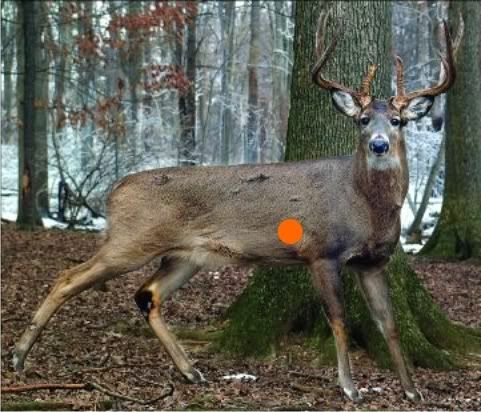
On Saturday a bowhunter from Ohio sent me an email in which he asks. "Where would you zero in on a deer? My stand is 15 feet high in a tree.” This is not much to go by to give a sound recommendation

There are two variables to consider, besides stand height, in estimating the aim point. How far from the stand is the deer? How fast is the bow you’re shooting?

Regardless of stand height and distance of the deer from the stand, I always recommend aiming low. There are two reasons for that suggestion. Shots that are taken from any height always impact higher than the same shot taken form the same level as the target. Second, if the deer jumps the string the impact will be higher again. It is a fact that most deer missed from treestands are missed high. Go figure.

How low you have to aim depends entirely on the speed of your bow and the distance from the target. The best way to learn where you have to aim is to practice with your bow from various stand height and target distances. Once you have established the difference you either can adjust your sight pins accordingly, or do as I do and commit the aim point to memory.

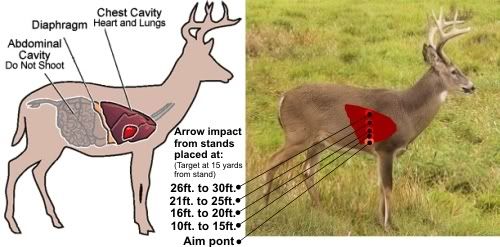
Here is a chart that I made up from data gathered from my treestand shooting practice. Mine is a moderate speed bow and as I said earlier, the impact varies with the speed of the bow and weight of the arrows.

Here is where I genearlly aim from my average stand height of 15ft and the deer at 15 to 25 yards from the stand.


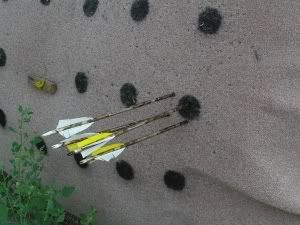
And here is a chart of what my practise arrow(*) imapcts look like with the same point of aim but different stand heights. (Click image for larger view.)


Update:
(*) After an angry email from a non-hunter I might mention that “practice” arrows are not shot at life animals, as the email writer assumed from my post. It puzzels me how some people even would assume that hunters use life practice targets. All the shooting practice with the bow and establishing arrow flight pattern (trajectory) is done on targets and so called 3-D targets. 3-D targets a life sized targets resembling a deer or other game animal.


Tags: Tags: , Tags: , Tags:

Monday, July 28, 2008

Getting in Bowhunting Shape

© By Othmar Vohringer

Last year has been very busy and I didn’t plan on bowhunting so I never took the time to head to the archery range. This year is different. We finally have moved to our new house and most of my seminar engagement dates are finalized. Time to sit back and think of the upcoming bowhunting season. With the season opening in September it was time to head to archery range and practice.

On Saturday evening I drove the short distance to the Nicola Valley Fish and Game Club, wondering how my first bow shooting session in a year would turn out. Will I have the strength to pull that string back on the bow? Do I still know how to shoot a bow?

I stepped up to the 20-yard target set an arrow on the string, pulled back, aimed and released. Swiiiish –Thud it went. Would you look at that!! Iheard myself saying. The arrow stuck perfectly in the center of the target. Well that is easy. I thought as I nocked the second arrow and two seconds later it joined the first arrow less than an inch from the first arrow. After five rounds I was confident that – surprisingly to me –it seemed I hadn’t lost my ability to shoot my bow. Although a faint muscle pain in my back and shoulder reminded me that I need to do a lot more bow shooting to get the muscles back into shape too.

Encouraged I moved to the 30 yard target, the maximum distance I will shot at a live animal. Again the first group of three arrows hit the target smack in the middle, but not as close as I am used to it. A three-inch group might still be acceptable for hunting but it isn’t to me. While I was pleasantly surprised to get the arrows that close out to 30 yards after one year of not shooting I am also fully aware that I need to spend a lot more time at the archery range to get to where I can confidently take a shot at a deer.

While I am not an archer – I consider myself a bowhunter not an archer - aiming for points or stacking arrows on top of each other, I still want each and every single arrow to hit exactly where I am aiming at. This type of accuracy gives me the confidence I need in the field.

It is for that same reason that I do all my shooting under a variety of simulated hunting conditions that I may encounter. For the same reason I always shoot wearing my normal hunting garments, plus binoculars and game calls around the neck. My aim is to leave nothing to chance when that big buck stands under my treestand. I do not want to worry about -at that precise moment- that perhaps bulky clothing, binoculars and the position of the deer might interfere with my shooting accuracy.

In conversations with other bowhunters I have learned that the main reason for missing a deer mostly boiled down to one of these reasons:
  • The hunter was not prepared to take the shot.
  • The arrow went astray because something, mostly clothing, interfered with the bowstring.
  • The hunter did not expect the situation he was presented with.
To avoid such ugly surprises I have to practice exactly the same way as I hunt. Getting familiar to shoot a bow under different conditions and situations gives a hunter confidence when the moment of the truth arrives. And confidence in ones abilities will bring success.

Since, despite the first promising result, I am still not feeling confident in my shooting abilities I’ll head back to the archery range. For the next few weeks I will spend every single day shooting my bow until it becomes to me second nature again.

, , , , ,
Related Posts Plugin for WordPress, Blogger...