© By Othmar Vohringer
The best time to establish a mineral lick for deer is from late winter, after the bucks dropped their antlers, to early spring.
While deer only need small amounts of minerals for full antler development having no minerals, or not enough, will result in in less antler growth than what genetically might be possible. Minerals are not just important for antler growth but also for the overall health and development of deer, lactating does and growing fawns in particular.
How to establish a deer mineral lick?
Practically you can put minerals anywhere and deer will eventually find it. However, to maximise the benefits for you and the deer it is best to place minerals where deer frequent. Look for topographical structures such as deer crossings, field and woodland corners, creek bottoms, ridges and saddles that are away from view of people or vehicle traffic. Find the secluded places that provide deer with a measure of security.
Although it is legal here in British Columbia to bait deer I do not use mineral licks for baiting deer. Just as I never place a stand directly over a food source or food plot.
Why not?
Because I want deer to feel safe on the lick or food source and keep returning to it regularly. Putting up a stand direct at the lick or food source will eventually make deer suspicious, resulting in deer abandoning it altogether. Also, it can be quite difficult to kill a deer at the lick or food source, especially for bowhunters, as deer constantly move around. I hunt the traveling deer. With that said, I place licks in such a way that it funnels the traveling deer past my stand location.
A lick can also be used to redirect deer traffic. Let me explain what I mean with a situation I faced last year. I hunted an area consisting of a large wide open field bordered on one side by thick brush and the road on the other side. Several trails went from the field into the brush but there was no predicting what particular trail the deer would use at any given time. Set up over one trail and deer move one of the other trails. Change stand locations to the trail the deer used and they would use the trail you sat over the day before. The brush is so thick you can’t see more than a few feet inside it. My solution to the problem? Redirect deer traffic by making a deer lick. I placed two mineral salt blocks inside the woodland on the thicket edge where the brush thins out. Checking the mineral lick in late winter I noticed that the deer established a large well used trail leading from the thicket to the mineral lick.
I recharged the lick with new mineral salt blocks early this year and the deer still hitting it strong. Come summer, around July, I will hang a stand on the new trail between the thicket and the mineral lick, refresh the lick again and leave the area alone until September, the beginning of the fall archery season.
Preparing a deer lick station.
When you found a good spot to establish a deer mineral lick don’t just dump the minerals in a pile on the ground. If there’s a rotten tree stump on the spot hollow it out and then pour mineral granulates into it. If there’s no tree stump clear a spot of about 5 to 8 feet in diameter down to bare soil. Spread lightly and evenly with mineral granulates. Check back in intervals of about one month and replenish minerals as needed.
If you use mineral blocks, as I do, clear a spot down to the soil and place the mineral block in the middle of it. To give the lick a quick start, or as an additional attractant, you can spread a few handful of grain or chopped apples around the mineral block. Unlike mineral granulates there’s no need to check mineral blocks frequently. The mineral blocks I put out in late winter last year still were in good shape this spring, unlike the mineral granulates I used for another lick station that were completely gone. Refreshing mineral licks for several seasons will saturate the soil to the point where deer will begin to eat the soil too, making it a traditional lick that deer and other wildlife will return to every day for many years. Hanging a trail camera near the mineral lick will have the benefit that you can check what deer and other wildlife visit and on what time of day. Cameras also let you keep taps on the antler growth of the bucks.
Give mineral licks a try this season, it’s an affordable way to help the deer getting important minerals and if placed correctly can improve your hunting success rate too.
Showing posts with label Hunting Tactics. Show all posts
Thursday, April 09, 2015
Thursday, November 20, 2014
Hunting Bucks On Public Land
© By Othmar Vohringer
I am probably not wrong with the assumption that most hunters in America and here in Canada hunt on public land. Here in North America we’re extremely lucky to have so much public land available to hunt. No matter where you live you never have to drive far to access public hunting land. The downside of public land hunting is that you have a lot of competition from other hunters, and that means hunting educated deer that are masters at humiliating hunters. Many hunters are of the opinion that public land does not hold big mature bucks, but looking at the Pope &Young or Boone & Crockett records will quickly reveal that every year a fair number of trophies are entered that have been taken on public land.
With that said, it is absolutely possible to take a big buck on public land. However, to do so you have to abandon everything that you have read or heard about buck hunting strategies. Most of the tactics discussed in the hunting media pertains to private land deer. Since I hunt most of the time public land deer I will reveal here what I have learned over the past 10 to 15 years.
Pay attention to the competition.
Humans are lazy and habitual. This means that hunters rarely venture far from the truck and almost always walk the same route and hunt the same spots season after season. Knowing this is important for the successful public land hunter. One of my preferred public land scouting times is right after the season closes. It is then that I am able to see the “sign” hunters have left behind and make notes of it. Just remember this, on public land hunters influence deer movement patterns.
Scout from home.
Google Earth has become for me a vital public land scouting tool. It is on Google Earth where I can clearly see the structure and layout of the land before I even set foot onto the land. When I look at Google Earth I look for spots that other hunters often overlook. Out of the way places and locations that don’t look like deer holding areas peak my interest. Often a small woodlot out in the open is overlooked by other hunters and so are small swampy areas and places that are not easily accessible. Most hunters head for the field edges and the big timber. These are the areas deer go to ones the pressure intensives knowing that no hunter will bother them there.
Check the boundaries.
Public land often borders onto private farmland. Walking the boundaries will reveal deer trails that lead from the public land onto private land. Often times these trails are used by the deer during hunting season as escape routes, hanging a stand near such trails can provide you with good hunting opportunities. Just be early in the stand and wait for the other hunters to enter the land and push deer your way.
Barriers.
Many public hunting lands have rivers and streams flowing through them. Most hunters wouldn’t think of crossing waterways or are not equipped to do so. Deer on the other hand have no hesitation whatsoever to get their feet wet crossing rivers and streams to escape from hunters onto small islands, into swampy or tall grass patches. Walking along such waterways after the hunting season closes will show where deer cross rivers and streams. I’ve made it many years ago a practice of mine to always carry a pair of hip and chest waders with me when I scout and hunt on public land.
Conclusion.
Hunting public land can be frustrating and almost always is hard work. But rather than letting hunting pressure get to you, do as the deer do. Avoid the hunting pressure and other hunters by finding the places that other hunters overlook or can’t be bothered to get to it. With a little effort and scouting right after hunting season closes you will find these deer refuge areas.
I am probably not wrong with the assumption that most hunters in America and here in Canada hunt on public land. Here in North America we’re extremely lucky to have so much public land available to hunt. No matter where you live you never have to drive far to access public hunting land. The downside of public land hunting is that you have a lot of competition from other hunters, and that means hunting educated deer that are masters at humiliating hunters. Many hunters are of the opinion that public land does not hold big mature bucks, but looking at the Pope &Young or Boone & Crockett records will quickly reveal that every year a fair number of trophies are entered that have been taken on public land.
With that said, it is absolutely possible to take a big buck on public land. However, to do so you have to abandon everything that you have read or heard about buck hunting strategies. Most of the tactics discussed in the hunting media pertains to private land deer. Since I hunt most of the time public land deer I will reveal here what I have learned over the past 10 to 15 years.
Pay attention to the competition.
Humans are lazy and habitual. This means that hunters rarely venture far from the truck and almost always walk the same route and hunt the same spots season after season. Knowing this is important for the successful public land hunter. One of my preferred public land scouting times is right after the season closes. It is then that I am able to see the “sign” hunters have left behind and make notes of it. Just remember this, on public land hunters influence deer movement patterns.
Scout from home.
Google Earth has become for me a vital public land scouting tool. It is on Google Earth where I can clearly see the structure and layout of the land before I even set foot onto the land. When I look at Google Earth I look for spots that other hunters often overlook. Out of the way places and locations that don’t look like deer holding areas peak my interest. Often a small woodlot out in the open is overlooked by other hunters and so are small swampy areas and places that are not easily accessible. Most hunters head for the field edges and the big timber. These are the areas deer go to ones the pressure intensives knowing that no hunter will bother them there.
Check the boundaries.
Public land often borders onto private farmland. Walking the boundaries will reveal deer trails that lead from the public land onto private land. Often times these trails are used by the deer during hunting season as escape routes, hanging a stand near such trails can provide you with good hunting opportunities. Just be early in the stand and wait for the other hunters to enter the land and push deer your way.
Barriers.
Many public hunting lands have rivers and streams flowing through them. Most hunters wouldn’t think of crossing waterways or are not equipped to do so. Deer on the other hand have no hesitation whatsoever to get their feet wet crossing rivers and streams to escape from hunters onto small islands, into swampy or tall grass patches. Walking along such waterways after the hunting season closes will show where deer cross rivers and streams. I’ve made it many years ago a practice of mine to always carry a pair of hip and chest waders with me when I scout and hunt on public land.
Conclusion.
Hunting public land can be frustrating and almost always is hard work. But rather than letting hunting pressure get to you, do as the deer do. Avoid the hunting pressure and other hunters by finding the places that other hunters overlook or can’t be bothered to get to it. With a little effort and scouting right after hunting season closes you will find these deer refuge areas.
Tuesday, November 18, 2014
Call and Rattle In Rutting Bucks
© By Othmar Vohringer
In all fairness it needs to be said that there are places where rattling and calling simply does not work well, mostly because deer wised up to the excessive amount of fake buck fighting and calling. This holds especially true on public land. It also holds true in areas where the buck to doe ratio is skewed in favor of the does. In such areas, which is almost everywhere were deer are not managed for an equal buck to doe ratio, bucks simply have no need to fight for breeding rights.
Yet, even in areas with skewed buck to doe ratios you can have success with calling and rattling a buck to your stand. Forget about aggressive calling and mimicking life-and-death buck battles. Instead tone it down a notch or two. Instead of aggressive rattling stick to “tickling” the antlers together, mimicking a sparring match between two bucks. This is often all it takes to get a buck curious and come investigating. Actually to tell the truth, I have much more success with gentle rattling than with banging aggressively the antlers together. My thinking is that even a large buck would rather come to investigate a sparring match than a full blown fight where he has to risk getting his butt kicked.
What applies for rattling also applies for calling. My experience is that many hunters make three mistakes when calling deer. These are; calling to loud, calling too often and to aggressive. Deer are gentle creatures that don’t like to be yelled at they also do not talk nonstop with each other and are seldom aggressive. When I call deer I strictly call deer that I can see. Blind calling has seldom worked for me. To call in bucks during the rut I stick to soft doe bleats. I keep it short, no more than two to three bleats and then I put the call away. If the buck hears the call he will either respond or not. If he doesn’t respond more calling will rarley change his mind. In fact I found quite often that by calling more the buck becomes suspicious and either walks away or if he does come in will hang up in thick cover.
How you’re set up will also play a big role in how effective deer calling and rattling works. Setting up a stand on deer trail intersections and near funnels yields the best results, deer rarely go out of their way to investigate a call. In the morning stands near doe bedding area are a good choice as bucks will frequent these places in the search of does. In the evening take a stand near a doe feeding area as the bucks will be hanging out there too. While it is true that bucks travel constantly during the rut they do not so randomly. The bucks know where the different groups of does bed and feed and they cruse from one group to the next on established routes. In other words, where the does are bucks aren’t too far from them.With that said, stick with the does and the bucks will not be far away.
Conclusion:
Tone your calling and rattling down a notch or two. Set up near the does because that is where the bucks will be too and if you want to make the illusion perfect to fool a buck with rattling and calling use a decoy as well. Attract a buck by sound and then confirm what he heard by providing him with a visual stimuli.
In all fairness it needs to be said that there are places where rattling and calling simply does not work well, mostly because deer wised up to the excessive amount of fake buck fighting and calling. This holds especially true on public land. It also holds true in areas where the buck to doe ratio is skewed in favor of the does. In such areas, which is almost everywhere were deer are not managed for an equal buck to doe ratio, bucks simply have no need to fight for breeding rights.
Yet, even in areas with skewed buck to doe ratios you can have success with calling and rattling a buck to your stand. Forget about aggressive calling and mimicking life-and-death buck battles. Instead tone it down a notch or two. Instead of aggressive rattling stick to “tickling” the antlers together, mimicking a sparring match between two bucks. This is often all it takes to get a buck curious and come investigating. Actually to tell the truth, I have much more success with gentle rattling than with banging aggressively the antlers together. My thinking is that even a large buck would rather come to investigate a sparring match than a full blown fight where he has to risk getting his butt kicked.
What applies for rattling also applies for calling. My experience is that many hunters make three mistakes when calling deer. These are; calling to loud, calling too often and to aggressive. Deer are gentle creatures that don’t like to be yelled at they also do not talk nonstop with each other and are seldom aggressive. When I call deer I strictly call deer that I can see. Blind calling has seldom worked for me. To call in bucks during the rut I stick to soft doe bleats. I keep it short, no more than two to three bleats and then I put the call away. If the buck hears the call he will either respond or not. If he doesn’t respond more calling will rarley change his mind. In fact I found quite often that by calling more the buck becomes suspicious and either walks away or if he does come in will hang up in thick cover.
How you’re set up will also play a big role in how effective deer calling and rattling works. Setting up a stand on deer trail intersections and near funnels yields the best results, deer rarely go out of their way to investigate a call. In the morning stands near doe bedding area are a good choice as bucks will frequent these places in the search of does. In the evening take a stand near a doe feeding area as the bucks will be hanging out there too. While it is true that bucks travel constantly during the rut they do not so randomly. The bucks know where the different groups of does bed and feed and they cruse from one group to the next on established routes. In other words, where the does are bucks aren’t too far from them.With that said, stick with the does and the bucks will not be far away.
Conclusion:
Tone your calling and rattling down a notch or two. Set up near the does because that is where the bucks will be too and if you want to make the illusion perfect to fool a buck with rattling and calling use a decoy as well. Attract a buck by sound and then confirm what he heard by providing him with a visual stimuli.
Labels:
Hunting Tactics,
Hunting Tactics - Rut,
Hunting Tips
Friday, November 14, 2014
Rut Tactics: Using Decoys To Bring In Bucks
© By Othmar Vohringer
Using a deer decoy during the rut to lure a buck to your stand or ground blind can work extremely well. But like everything else, decoying has to be done right. Just randomly setting up decoys and hope for the best is bound to fail. In this segment of Rut Tactics I will provide you with a few tips on how to make your decoy set ups get noticed by bucks.
Timing:
To have any chance at decoying success the timing has to be perfect. Used at the right time, a decoy can significantly increase the chances of a buck responding to it. Fail to get the timing right and bucks will ignore the decoy, or worse get spooked by it. My experience is that the best time for decoying begins in the pre-rut phase and right up to the peak of the rut. The closer it gets to the peak rut the better is the likelihood that a mature buck will respond to your decoy.
Why is timing so important? During the rut bucks are single minded driven to breed every doe that they can get and to fight every buck for it. In their breeding frenzy a roaming buck will be attracted by anything that looks like a deer.
Another important consideration of timing is to set the decoy up when you hunt and not before. This seems to make sense but I have encountered hunters that set up decoys the evening before they hunt. It’s a big mistake to do this. The whole premise of decoying is to fool a buck into believing that there is an actual deer and not to give him time to figure out that the decoy is a fake deer.
Presentation:
![]() |
| A typical decoy set up using existing deer travel funnels . |
First, the decoy has to be set up where deer are traveling, meaning active deer travel routes. Deer, even a lovesick buck, will not go out of their way to investigate something that looks like a deer when he knows that it is not an active travel route. In fact he will get suspicious about it. In my experience the best place for decoys are funnels and crossing points. The bottom line is. You need to be where deer will travel and see your decoy.
A decoy should always be placed where bucks can spot them form a fair distance away (see image above). You also have to pay close attention to the wind. Bucks often try to approach decoys from downwind. Make sure that the buck cannot go downwind from your stand position without stepping into one of your shooting lanes first.
Next pay close attention in which direction the decoy faces. There are several opinions where a decoy should face, while some believe a decoy should face away from the hunter, others are of the opinion that the decoy should face the hunter. From experience I share the later opinion. Here is why. When a buck approaches a deer he tries to get downwind from it to scent check it. Then the buck approaches the deer from the front, he wants to look the other deer into the eyes. As the buck turns to face the decoy he will at some point come broadside of me and give me a shot. By doing so the buck is fully focused on the decoy, he will not notice when you shoulder your rifle or draw your bowstring. Conversely, if the decoy faces away from you and the buck approaches it he will look in your direction and might see you move. Because of how a buck approaches another deer, in this case a decoy, it is important to place the decoy in such a way that the wind blows directly from the decoy to you and that the decoy faces you.
How far should the decoy be placed from the hunter’s position? That depends what you’re shooting with. If I hunt with a bow I place the decoy no more than 30 yards from the stand, preferably a little closer. With a firearm the decoy can be placed further away from the setup, provided the decoy is still clearly visible to any approaching bucks. Distance from the hunter to the decoy is important because a buck will typically keep a safe distance from the decoy before they walk right up to it. Preferably I like to get a shot at the buck before he walks right up to the decoy. It doesn’t take very long for some bucks to figure out that a decoy is a fake deer, then swaps ends and departs in a hurry.
Should I use a buck or doe decoy?:
Most of the time I use a buck decoy and sometimes a buck and doe together, the later seems to work especially well if the buck decoy mimics a smaller buck. A larger buck will have no hesitation to come rushing in, trying to run the smaller buck off.
I rarely use a single doe decoy, as my experience has been that it attracts mostly other does and fawns. What I have experienced a time or two with single doe decoys is that an older doe got suspicious, somehow these older girls seem to have sixth sense of things that are not quite right. It is these older does that can make all other deer nervous with their paranoia and eventually convince the others deer to vacate the area and by doing so take bucks that might lurk around with them. By using a buck decoy the does will usually stay clear of it. Bucks on the other hand will approach the decoy with the full intention of kicking this intruder’s butt, especially if the decoy as I said earlier mimics a smaller buck.
Complete the illusion:
When I use decoys I want to create a lifelike illusion. To do that I use scents, calls and rattling antlers that are appropriate for the time of the rut.
Conclusion:
If you haven’t had much luck decoying deer in the past, try some of the tips provided here and see how decoying deer can work for you too. I am often asked whether full body or silhouette decoys are better. Personally I like the silhouette decoys from Montana Decoys. These decoys look lifelike and fold up to a small format that will fit easily into a backpack. To me this is important. Especially when I use a climbing treestand, spot and stalk or have to hike a long way to my stand, I don’t feel that I also should burden the load by carrying a life-sized full body deer decoy when the are other options that work as well as a Montana Decoy.
Wednesday, November 12, 2014
Getting In And Out Of Your Stand Undetected
© By Othmar Vohringer
As hunters we invest a considerable amount of time in scouting and finding features that promote deer travel, locating food sources and the perfect stand locations. Yet, few hunters pay any mind whatsoever to finding out how they will get in and out of their stand locations undetected by deer. I lost count of how many times I heard stories of hunters that got busted by deer on their way to and from their stands. It happened to me too, more often then I care to admit.
But I learned from my own mistakes and for many years now pay close attention to the routes in and out of my stands. Choosing the perfect route to access or depart your stand is just as important as finding the perfect stand location. Before hanging a stand, find out how you can access and leave without letting deer know that you’re in the area. Because if you can’t do that the best stand location will be ruined for future hunts, you might just as well pull it.
When I chose a stand location I make careful notes of where deer will be during those times that I hunt a particular stand, pre-season and careful in-season scouting will reveal these areas. If deer can hear, see or smell me on my way in or out I am done. Deer stay alive by exactly knowing what is going on all around them and who’s coming and going.
When choosing entry and exit routes we have to pay close attention to wind directions and how air currents behave in the area. That is the reason why it is so important to know your hunting area so well, not only to figure out deer movement patterns but also to figure out how you get undetected in and out. Finding the perfect stand access and departure route means that we often have to choose several routes, quite often the route we come in to the stand might not be the same we can use to leave the stand. Quite often it also means that we have to walk a considerable detour. One of my best stand locations required a boat to access and depart from it. It took me an extra half hour instead of the 15 minutes the direct route would have taken me. The extra minutes and requiring a boat was well worth the effort and time as the stand kept producing deer hunt after hunt and season after season. Seldom is the shortest and easiest way also the best way.
The next time you experience that your stand doen't come up to your expectations give it some serious consideration about how to get into and out of your stand location without alerting every deer in the vicinity to your presence.
As hunters we invest a considerable amount of time in scouting and finding features that promote deer travel, locating food sources and the perfect stand locations. Yet, few hunters pay any mind whatsoever to finding out how they will get in and out of their stand locations undetected by deer. I lost count of how many times I heard stories of hunters that got busted by deer on their way to and from their stands. It happened to me too, more often then I care to admit.
But I learned from my own mistakes and for many years now pay close attention to the routes in and out of my stands. Choosing the perfect route to access or depart your stand is just as important as finding the perfect stand location. Before hanging a stand, find out how you can access and leave without letting deer know that you’re in the area. Because if you can’t do that the best stand location will be ruined for future hunts, you might just as well pull it.
When I chose a stand location I make careful notes of where deer will be during those times that I hunt a particular stand, pre-season and careful in-season scouting will reveal these areas. If deer can hear, see or smell me on my way in or out I am done. Deer stay alive by exactly knowing what is going on all around them and who’s coming and going.
When choosing entry and exit routes we have to pay close attention to wind directions and how air currents behave in the area. That is the reason why it is so important to know your hunting area so well, not only to figure out deer movement patterns but also to figure out how you get undetected in and out. Finding the perfect stand access and departure route means that we often have to choose several routes, quite often the route we come in to the stand might not be the same we can use to leave the stand. Quite often it also means that we have to walk a considerable detour. One of my best stand locations required a boat to access and depart from it. It took me an extra half hour instead of the 15 minutes the direct route would have taken me. The extra minutes and requiring a boat was well worth the effort and time as the stand kept producing deer hunt after hunt and season after season. Seldom is the shortest and easiest way also the best way.
The next time you experience that your stand doen't come up to your expectations give it some serious consideration about how to get into and out of your stand location without alerting every deer in the vicinity to your presence.
Labels:
Hunting Tactics,
Hunting Tips,
Scouting,
Tip of the Week
Monday, November 10, 2014
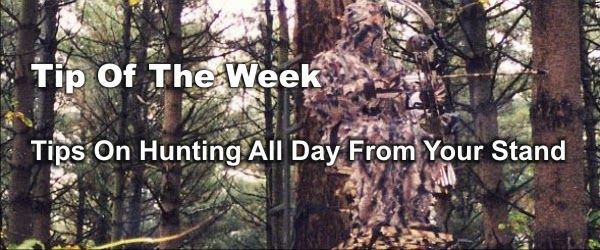
Tips On Hunting All Day From Your Treestand
© By Othmar Vohringer
During the rut, when bucks move at every hour of the day, sitting from dawn to dusk in your treestand can be a great way to kill a mature buck. Sitting up to ten hours, or more, in your stand is no easy task, but if you plan ahead and use the right gear and set of mind an all day treestand sit can be very productive and will not become a battle of endurance. To that end I share with you a few tips that I learned over the years to make hunting all day from a stand comfortable.
1. Confidence: The lack of confidence is the biggest killer of staying all day in your treestand. There are times when nothing moves for hours. I’ve spent sitting hours upon hours without seeing any deer and it lets you question the purpose of sitting in your stand, especially when you hear a shot or two going off in the distance. You have to have confidence in your skills to scout and hang stands accordingly. Without that you will start to doubt and wonder if the grass is greener elsewhere. Without confidence all other tips that follow will become useless as the lack of confidence that will make you to abandon an all day stand sit in.
2. Comfort: The next important aspect of all day treestand hunting is comfort. If you’re not comfortable you go home to early. To be comfortable you need to wear the right clothing for the weather that keeps you warm. During the rut weather patterns can change often during a single day, frost in the morning and evening, warm during midday hours. Always check the weather forecast of the area you’re hunting and make clothing choices accordingly. Dress in approbriate layers of undergarments. I usually pack rain gear and extra insulated clothing that I carry with me to the treestand in a day day-pack. On my walk to the stand I dress in lightly to avoid sweating. At the stand location I add an insulated parka and bib pants over the clothing I already wear. As the day progresses I shed some of the outer layers and add them again in the evening as it gets colder. Don’t forget hands, feet and face. Cold hands, feet or face will make the whole body feel cold. To cover for that I always carry an insulated neck and face cover, insulated cloves and wear thick will socks over a pair of lightweight socks.
When we talk about comfort treestands come to mind. Although treestand seats have come a long way from the old canvas sling seat or foam covered wooden board, it still can take a toll on your posterior so sit on these things for a full day. If you have to carry an additional thick foam mat or one of those inflatable seat cushions and a padded backrest that you can attach to the tree to make you comfortable for many hours of sitting. If you’re not comfortable seating on your stand it will lead to moving around too much and eventually leaving early because your backside just can’t take it anymore.
3. Nutrition: In order to stay warm and content the body needs fuel to keep the internal furnace going and the mind sharp. In other words, you can’t hunt all day without eating and drinking liquid. When I hunt all day I do not carry full pre-cooked meals with me, instead I substitute with high energy foods that a lighter to pack than a thermos filled with stew. Such high energy foods are trail mix containing various sorts of nuts and dehydrated fruit, an assorted collection of chocolate and granola bars and maybe even some beef jerky. To drink I always have two to three small bottles of plain water with me and occasionally a thermos with chicken or beef broth. Snaking all day long is better than eating lots in one go. Eating a “meal” makes you sleepy and that is not what you want to happen in a treestand.
4. Preventing boredom: Sitting all day in a treestand can get boring, especially if you there is no deer movement for hours, and it can quickly lead to a nagging desire to leave. To relieve boredom I bring a book along to an all day treestand sit-in. I choose a book that does not need my full concentration to follow a story, but rather choose a bock for entertainment value. If own a cell phone or similar device you can download a book or your favourite hunting.
However, I strongly advice not use the device to cruse the internet and get distracted with social media discussions, not even the discussions on the Whitetail Deer Passion Facebook site, save that for later when the hunt is over. Also video games can relieve boredom. Whatever it is you do to keep from getting bored, make sure it does not distract you from what is going on around you, always remember. Your main purpose is to hunt and pay attention. If you forget this it can happen to you like to a friend of mine who sent me a text message during his hunt. As we texted back and forth my friend texted back; “Shit a big buck just walked by the stand and I couldn’t drop the phone and grab the bow quick enough.” Yes it can happen that quickly. Nothing moves for hours and then when you least expect it the buck of your dreams walks right under your stand. Don’t get distracted.
5. Answering the call of nature: Nothing puts a damper to hunting more than having to go and not being able to go. As the saying goes; if you have to go you have to go. At one time there has been a big market for an assortment treestand nature call gadgets. Here is what I do when nature calls. I answer the call! For years I was worried that the scent of human urine and feces would spook deer. Then I read about a research that has been done on that matter and what you know? Deer are not spooked one little bit by it. Actually the research found that deer are attracted to the smell of human urine. So if I have to go I “let it rip” right then and there over the edge of my treestand and it never has bothered the deer any. For a bowl movement I get one in the morning before I leave the house and that usually takes care of it all day long. Avoiding a bowl movement in the middle of an all day hunt is another good reason snack rather than eat lots of food in one go.
Labels:
Hunting Tactics,
Hunting Tactics - Rut,
Hunting Tips
Saturday, November 08, 2014
Rut Myth Debunked – When the weather is to hot the rut will be delayed
© By Othmar Vohringer
Myth: When the weather is to hot the rut will be delayed.
Fact:
Remember when I wrote in an earlier segment of “Rut Myth Debunked” that the rut is closely tied to the time of the fawn birth. Weather therefore will have very little influence on the rut activity because the fawns need to be born during a very particular time of the year or else their chances of survival will drop significantly. While it appears that a freak warm weather front shuts the rut down, the truth is that the rut is going to happen regardless. Deer biologists have done a great deal of research on this myth of a delayed rut and found out that warm weather may force the bucks to slow down somewhat but they will keep on seeking out and breeding does regardless. While in cold weather bucks cruse around during daylight hours in search of receptive they will rest during warm periods and search for does mainly at night.
Whatever the weather conditions are the rut will happen regardless because nature demands it to happen.
Hot weather will not delay the rut for weeks, or as some hunters have suggested, cancel the rut. Conversely, a premature cold snap will not result in kick-starting the rut weeks earlier either. If you’ve figured out at what time the rut is on in the area you hunt then go hunting regardless of the weatherman’s predictions of a warm weather front. During these warm weather periods take up a stand further back into the timber, near a buck bedding area, and expect buck movement right at dawn and shortly before dusk.
Myth: When the weather is to hot the rut will be delayed. Fact:
Remember when I wrote in an earlier segment of “Rut Myth Debunked” that the rut is closely tied to the time of the fawn birth. Weather therefore will have very little influence on the rut activity because the fawns need to be born during a very particular time of the year or else their chances of survival will drop significantly. While it appears that a freak warm weather front shuts the rut down, the truth is that the rut is going to happen regardless. Deer biologists have done a great deal of research on this myth of a delayed rut and found out that warm weather may force the bucks to slow down somewhat but they will keep on seeking out and breeding does regardless. While in cold weather bucks cruse around during daylight hours in search of receptive they will rest during warm periods and search for does mainly at night.
Whatever the weather conditions are the rut will happen regardless because nature demands it to happen.
Hot weather will not delay the rut for weeks, or as some hunters have suggested, cancel the rut. Conversely, a premature cold snap will not result in kick-starting the rut weeks earlier either. If you’ve figured out at what time the rut is on in the area you hunt then go hunting regardless of the weatherman’s predictions of a warm weather front. During these warm weather periods take up a stand further back into the timber, near a buck bedding area, and expect buck movement right at dawn and shortly before dusk.
Labels:
About Whitetail Deer,
Hunting Tactics,
Hunting Tactics - Rut,
Hunting Tips,
Smart Hunting Strategy
Thursday, November 06, 2014
Rut Myth Debunked – Does the full moon have an effect on the timing of the rut?
© By Othmar Vohringer
Myth: The full moon has an effect on the timing of the rut.
Fact:
This is another myth that many hunters have unquestioningly adhered to for generations. I know of quite a few hunters that won’t go hunting until the “moon is right”, despite the fact that science has never been able to support that moon theory. Many notable deer behaviour scientists have examined this issue at great length and all they could come up with is that there is no definitive relationship between the moon and the timing of the rut.
If you look at the bigger picture this makes sense. The moon phases are the same across North America and with that we can assume that if the moon would have any influence on the timing of the rut that it would have that affect across the continent. But that is not so. The timing of the rut varies from the south to the north by as much as two months. There are more questions to the deer rut then we have answers for but one thing scientists are very sure about is that the timing of the rut is directly linked to the time when fawns are born.
The fawns are born when the climate and food availability guarantees the best possible survival chances. In Florida the best climatic conditions for deer to raise offspring is March and further north, like British Columbia, Canada (the most northerly extension range of whitetails) the best conditions occur around the end of May to the beginning of June for most regions. To establish the beginning of the rut all one has to do is pay close attention to the time of when the deer fawns are born. From there count back 120 to 125 days (the gestation period of whitetail deer) and that will provide you with a good ballpark figure of when the rut starts in your particular area.
Here is another interesting bit that refutes the full moon rut trigger myth. When a southern Texas game ranch imported whitetail deer from Wisconsin they found out that it took the Wisconsin deer a full two years to adjust to the Texas deer rut cycle. Why? Climate! When southern Texas deer give birth to fawns most of Wisconsin is still under a blanket of snow and frost.
If you still doubt that the moon has absolutely nothing to do with the rut then you might want to read what modern whitetail deer researchers have discovered.
Read the next segment of "Rut Myth Debunked"
Is the rut the best time to hunt mature bucks?
Hunting bucks by setting up over a scrape
Myth: The full moon has an effect on the timing of the rut.
Fact:
This is another myth that many hunters have unquestioningly adhered to for generations. I know of quite a few hunters that won’t go hunting until the “moon is right”, despite the fact that science has never been able to support that moon theory. Many notable deer behaviour scientists have examined this issue at great length and all they could come up with is that there is no definitive relationship between the moon and the timing of the rut.
If you look at the bigger picture this makes sense. The moon phases are the same across North America and with that we can assume that if the moon would have any influence on the timing of the rut that it would have that affect across the continent. But that is not so. The timing of the rut varies from the south to the north by as much as two months. There are more questions to the deer rut then we have answers for but one thing scientists are very sure about is that the timing of the rut is directly linked to the time when fawns are born.
The fawns are born when the climate and food availability guarantees the best possible survival chances. In Florida the best climatic conditions for deer to raise offspring is March and further north, like British Columbia, Canada (the most northerly extension range of whitetails) the best conditions occur around the end of May to the beginning of June for most regions. To establish the beginning of the rut all one has to do is pay close attention to the time of when the deer fawns are born. From there count back 120 to 125 days (the gestation period of whitetail deer) and that will provide you with a good ballpark figure of when the rut starts in your particular area.
Here is another interesting bit that refutes the full moon rut trigger myth. When a southern Texas game ranch imported whitetail deer from Wisconsin they found out that it took the Wisconsin deer a full two years to adjust to the Texas deer rut cycle. Why? Climate! When southern Texas deer give birth to fawns most of Wisconsin is still under a blanket of snow and frost.
If you still doubt that the moon has absolutely nothing to do with the rut then you might want to read what modern whitetail deer researchers have discovered.
Read the next segment of "Rut Myth Debunked"
Is the rut the best time to hunt mature bucks?
Hunting bucks by setting up over a scrape
Tuesday, November 04, 2014
Rut Myth Debunked – Hunting bucks by setting up over a scrape
© By Othmar Vohringer
Myth: During the rut taking up a stand near a fresh scrape means better odds that a great buck will come by.
Fact:
Here’s the skinny on scrapes. Did you know that over 90% of all scrapes are random? Meaning, the buck that made them will never return to it again? But hang on, it gets worse. Does make scrapes too and no, you can’t tell the difference from a buck and doe scrape. Scrapes come in all sizes from as big as a car-hood to as small as a dinner plate and neither is an indicator of what size deer made them. Some scrapes are only used by bucks, others only by females and again others are used by both sexes. Then there is the little known fact that the majority of mature bucks visit scrapes primarily at night as a recent study revealed with radio collared bucks. Now add to this confusion that a buck can make up to 40 or more scrapes in his territory of which none is regularly visited and others never attended to again and it becomes obvious how slim the chances are to plan on encountering a buck at a specific scrape.
All these limiting factors may be the reason for the answers I got from “scrape hunters” when I asked them about the success ratio they have by employing this particular hunting tactic. It can be summed up like this: if you hunt over the same scrape from dawn to dusk for several days, even weeks, and a buck will eventually walk by it. To me that sounds more like depending on luck - not a sound strategy.
Read the next segment of "Rut Myth Debunked"
Is the rut the best time to hunt mature bucks?
Does the full moon have an effect on the timing of the rut?
Myth: During the rut taking up a stand near a fresh scrape means better odds that a great buck will come by.
Fact:
Here’s the skinny on scrapes. Did you know that over 90% of all scrapes are random? Meaning, the buck that made them will never return to it again? But hang on, it gets worse. Does make scrapes too and no, you can’t tell the difference from a buck and doe scrape. Scrapes come in all sizes from as big as a car-hood to as small as a dinner plate and neither is an indicator of what size deer made them. Some scrapes are only used by bucks, others only by females and again others are used by both sexes. Then there is the little known fact that the majority of mature bucks visit scrapes primarily at night as a recent study revealed with radio collared bucks. Now add to this confusion that a buck can make up to 40 or more scrapes in his territory of which none is regularly visited and others never attended to again and it becomes obvious how slim the chances are to plan on encountering a buck at a specific scrape.
All these limiting factors may be the reason for the answers I got from “scrape hunters” when I asked them about the success ratio they have by employing this particular hunting tactic. It can be summed up like this: if you hunt over the same scrape from dawn to dusk for several days, even weeks, and a buck will eventually walk by it. To me that sounds more like depending on luck - not a sound strategy.
Read the next segment of "Rut Myth Debunked"
Is the rut the best time to hunt mature bucks?
Does the full moon have an effect on the timing of the rut?
Saturday, October 18, 2014
Early Season Deer Hunting Tips Roundup
© By Othmar Vohringer
The most common keywords used by readers of Whitetail Deer Passion over the last two weeks are; "early season deer calling", "early season deer hunting tips" and "early season deer scent".
With over 200 pages of deer hunting information on Whitetail Deer Passion it can be time consuming to find the right information at the lick of a button. To make life easier for you I did the search work for you and provide a collection of links to information about early season hunting tactics, deer calls and scent usage.
Enjoy!
There is a lot more information here on Whitetail Deer Passion about early season deer hunting, but I am convinced that the links above will provide you with a solid foundation of tips to get you started in the right direction to early season deer hunting success.
Best of luck to you all hunting the early deer season, stay safe and keep the Whitetail Deer Passion burning.
Labels:
About Whitetail Deer,
Equipment Tips,
Hunting Tactics,
Hunting Tactics - Archery,
Scouting,
Smart Hunting Strategy,
Tip of the Week
Wednesday, October 01, 2014
The Most Common Mistakes When Setting Up Treestands That Will Reduce Your Hunting Success
© By Othmar Vohringer
As mentioned in another column here on Whitetail Deer Passion, there is no denying that the invention of the treestand is the single biggest advantage for deer hunters. However, to use the advantages of hunting from treestands to its fullest potential we have to make sure to set them up correctly. It is here were many hunters make blunders that cost them “deerly”.
Here are some of the mistakes hunters make and how to avoid them.
Going too high
The height of the treestand from the ground is determined by the surrounding cover. If the surrounding cover is optimal at 8 feet off the ground then that is where you should hang the stand. Hang the stand any higher and you risk to be sky lighted, deer will spot you from a mile away…and no they will not come any closer to see what that bulging blob on the side of the tree is. In my humble opinion the biggest myth ever perpetrated on hunters is that philosophy of climbing high up into the tree tops to avoid deer smelling you. To avoid deer from smelling me I rely on a good shower and a set of fresh clean under and over garments before every hunt and to make sure the wind is right for the stand I am hunting, if the wind is not right I will not hunt that particular stand and go elsewhere where the wind is in my favor. Tests have shown that no matter how high you climb deer will detect your scent. The tests have shown that when you go high, around 30 to 40 feet off the ground, the air current will carry your scent maybe 100 to 150 yards before it descends to ground level. Do you believe deer that smell a hunter 100 to 150 yards away will come closer to have a look where the smell of human is exactly coming from? Neither do I! On the other hand the same tests, done with smoke cartridges placed at various heights, showed that when the stand hangs lower, around 10 to 16 feet off the ground, the scent seems to linger around the base of the tree. In that scenario with the immediate surroundings of your stand site contaminated with human scent, you still stand a chance of getting deer within shooting range, even with a bow.
Another myth perpetrated by the “climb as high as you can” advocates is that the higher you climb the less likely deer will see you. Wrong! As I stated at the beginning, if you run out of surrounding cover you will stick out like the proverbial thumb against the sky. As much advantage as treestands have, hunting from them has also educated deer to look up into the treetops for danger. In areas where hunters predominantly hunt from treestands deer always will look up first before they look ahead and around. The popularity of hunting from treestands has taught generations of deer to look up for danger.
Hanging treestands at the wrong time
Hanging deer stands a few day or even weeks before the deer season opens is a sure recipe to spoil opening day hunting success. If you do your scouting right you should know what areas deer use on opening day, long before the deer move to that area. I hang my stands at the very least one to two months ahead of hunting season. That way the area can settle down and deer get used to the "new growth" on the tree. No matter how carful you are hanging stands it is noisy and the area is heavily contaminated with human scent. If you hunt on public land where it is not logical (stands do get stolen) or legal to hang treestands months in advance you can at the very least locate potential stand sites and do any necessary trimming and preparations. That way on opening day you can move in and carefully place your stand with low impact to the area. Having said that, I find it personally very important to practice setting up stands with the same commitment as shooting your gun or bow… and I will tell you why.
Practicing setting up stands makes it safer to use them because you're familiar with the procedure, but also there are times when a stand needs to be moved during the hunting season because deer travel patterns change. In these cases I move my stands during midday hours when the deer are resting in their bedding areas away from the travel corridors, trail intersections and feeding areas. Such stand location changes have to happen quickly and quietly. This is only possible to do if you are intimately familiar with setting up stands and that means practice and practice again until you have every move ingrained in your brain. I can take down a hang-on stand and set it up again safely in less than ten minutes. Of course, when you relocate a stand during hunting season you want to do so at the time of day when deer are bedded down.
Where possible a climbing treestand is much better suited for quick in season changes than a hang-on stand. To make changing stand locations quick and easy I select as many trees as I can and prepare them well before the hunting season opens. However, it must be said that climbing treestand models needing a lot of assembling are not well suited. The best models are those that only need an adjustment of the climbing cables, such as the Summit Climbers.
Ignoring the lay of the land and wind directions
The weather forecast predicts north easterly winds but don’t bet your farm on it that this holds true for your stand locations too. The topography of the land with its hills, valleys, gullies and slopes among many other features can and often do affect wind direction. In addition local thermals further affect where your scent will carry. The solution to this problem is to make sure where the wind and air currents drift. To determine that I always carry a used nasal-spray bottle filled with unscented red snap-line marking powder with me. When I squeeze the bottle I can see the red powder cloud for a long distance flowing with the breeze. This provides me with accurate information of what the wind and thermals are doing.
On that note, where ever possible I set up two stands in the same general location that way I can keep hunting by just going to the next stand when the wind or current changes. If you’re sold on scent eliminating products and clothing don’t think for a minute that deer will not smell you, because they will. I used to be fanatical about scent control, showered in scent eliminating products before every hunt, washed my clothing in scent eliminating laundry detergent, air dried and stored clothing in scent free vacuum sealing bags and wore a scent free coverall on the drive to the hunting area and used scent eliminating spray to treat my hunting gear after I left the truck, including hands head and boots. In addition I spent a fortune on scent eliminating lined camouflage garments and boots. Then one day I learned a very educational lesson that brought me back to reality about scent eliminating products. A buck came in from downwind, stuck his nose high in the air and took a deep breath, then he bolted away never to be seen again. The wind is not your friend, it is your enemy and you should always pay close attention to it.
Getting to and from your stand
How many hunters give any thought to stand entry and exit routes when they scout? My experience is that there are not many. It is a mistake that can you cost deer. It doesn’t take a degree is deer science to know that whitetails are very aware at all times what’s going on around them. The only way to outsmart the deer is to be very meticulous when scouting. Don’t just look for deer sings and a good place to hang a stand, also scout for your own entry and exit routes. The result of that consideration should be that you can enter and exit your stand site without letting the deer on what you’re doing, sometimes that means that the entry route is not the same as the exit route, or that you have to change the routes as the season goes by.
To close for comfort
Another mistake some hunters make in stand placement is that they go too close to deer feeding areas, food plots and bait. First of all it can be a very hard task to kill a deer at the feeding site and second, as studies have shown, as the season goes on deer avoid the food source more and more. No matter how careful you are in approaching or leaving the stand, eventually deer will catch on to you. The deer might not be aware of you but the minute changes and sign you leave behind each time you visit a stand site are often enough for deer to become wary and avoid the feeding area during legal shooting times. It is much better to place the stand back from the food source, preferably on intersecting trails where you will encounter much more deer traffic. Especially if you're after a buck it pays to hang the stand back from the food source. Mature bucks are notorious for hanging up in the woods and wait until nightfall before they enter the fields and food plots.
Over hunting
Hunting from the same stand every other day is a sure way to let it get “cold” in a hurry. My experience is that a stand should not be hunted more than two day per any given week, with at least two days rest in between. An old but very true saying among experienced deer hunters is; “The best chance to kill a deer from a treestand is the very first day you hunt from it.
So there you have it. I hope these tips will help you to become a better deer hunter. Feel free provide additional treestand hunting mistakes that you know or learned the hard way about it in our comment section.
As mentioned in another column here on Whitetail Deer Passion, there is no denying that the invention of the treestand is the single biggest advantage for deer hunters. However, to use the advantages of hunting from treestands to its fullest potential we have to make sure to set them up correctly. It is here were many hunters make blunders that cost them “deerly”.Here are some of the mistakes hunters make and how to avoid them.
Going too high
The height of the treestand from the ground is determined by the surrounding cover. If the surrounding cover is optimal at 8 feet off the ground then that is where you should hang the stand. Hang the stand any higher and you risk to be sky lighted, deer will spot you from a mile away…and no they will not come any closer to see what that bulging blob on the side of the tree is. In my humble opinion the biggest myth ever perpetrated on hunters is that philosophy of climbing high up into the tree tops to avoid deer smelling you. To avoid deer from smelling me I rely on a good shower and a set of fresh clean under and over garments before every hunt and to make sure the wind is right for the stand I am hunting, if the wind is not right I will not hunt that particular stand and go elsewhere where the wind is in my favor. Tests have shown that no matter how high you climb deer will detect your scent. The tests have shown that when you go high, around 30 to 40 feet off the ground, the air current will carry your scent maybe 100 to 150 yards before it descends to ground level. Do you believe deer that smell a hunter 100 to 150 yards away will come closer to have a look where the smell of human is exactly coming from? Neither do I! On the other hand the same tests, done with smoke cartridges placed at various heights, showed that when the stand hangs lower, around 10 to 16 feet off the ground, the scent seems to linger around the base of the tree. In that scenario with the immediate surroundings of your stand site contaminated with human scent, you still stand a chance of getting deer within shooting range, even with a bow.
Another myth perpetrated by the “climb as high as you can” advocates is that the higher you climb the less likely deer will see you. Wrong! As I stated at the beginning, if you run out of surrounding cover you will stick out like the proverbial thumb against the sky. As much advantage as treestands have, hunting from them has also educated deer to look up into the treetops for danger. In areas where hunters predominantly hunt from treestands deer always will look up first before they look ahead and around. The popularity of hunting from treestands has taught generations of deer to look up for danger.
Hanging treestands at the wrong time
Hanging deer stands a few day or even weeks before the deer season opens is a sure recipe to spoil opening day hunting success. If you do your scouting right you should know what areas deer use on opening day, long before the deer move to that area. I hang my stands at the very least one to two months ahead of hunting season. That way the area can settle down and deer get used to the "new growth" on the tree. No matter how carful you are hanging stands it is noisy and the area is heavily contaminated with human scent. If you hunt on public land where it is not logical (stands do get stolen) or legal to hang treestands months in advance you can at the very least locate potential stand sites and do any necessary trimming and preparations. That way on opening day you can move in and carefully place your stand with low impact to the area. Having said that, I find it personally very important to practice setting up stands with the same commitment as shooting your gun or bow… and I will tell you why.
Practicing setting up stands makes it safer to use them because you're familiar with the procedure, but also there are times when a stand needs to be moved during the hunting season because deer travel patterns change. In these cases I move my stands during midday hours when the deer are resting in their bedding areas away from the travel corridors, trail intersections and feeding areas. Such stand location changes have to happen quickly and quietly. This is only possible to do if you are intimately familiar with setting up stands and that means practice and practice again until you have every move ingrained in your brain. I can take down a hang-on stand and set it up again safely in less than ten minutes. Of course, when you relocate a stand during hunting season you want to do so at the time of day when deer are bedded down.
Where possible a climbing treestand is much better suited for quick in season changes than a hang-on stand. To make changing stand locations quick and easy I select as many trees as I can and prepare them well before the hunting season opens. However, it must be said that climbing treestand models needing a lot of assembling are not well suited. The best models are those that only need an adjustment of the climbing cables, such as the Summit Climbers.
Ignoring the lay of the land and wind directions
The weather forecast predicts north easterly winds but don’t bet your farm on it that this holds true for your stand locations too. The topography of the land with its hills, valleys, gullies and slopes among many other features can and often do affect wind direction. In addition local thermals further affect where your scent will carry. The solution to this problem is to make sure where the wind and air currents drift. To determine that I always carry a used nasal-spray bottle filled with unscented red snap-line marking powder with me. When I squeeze the bottle I can see the red powder cloud for a long distance flowing with the breeze. This provides me with accurate information of what the wind and thermals are doing.
On that note, where ever possible I set up two stands in the same general location that way I can keep hunting by just going to the next stand when the wind or current changes. If you’re sold on scent eliminating products and clothing don’t think for a minute that deer will not smell you, because they will. I used to be fanatical about scent control, showered in scent eliminating products before every hunt, washed my clothing in scent eliminating laundry detergent, air dried and stored clothing in scent free vacuum sealing bags and wore a scent free coverall on the drive to the hunting area and used scent eliminating spray to treat my hunting gear after I left the truck, including hands head and boots. In addition I spent a fortune on scent eliminating lined camouflage garments and boots. Then one day I learned a very educational lesson that brought me back to reality about scent eliminating products. A buck came in from downwind, stuck his nose high in the air and took a deep breath, then he bolted away never to be seen again. The wind is not your friend, it is your enemy and you should always pay close attention to it.
Getting to and from your stand
How many hunters give any thought to stand entry and exit routes when they scout? My experience is that there are not many. It is a mistake that can you cost deer. It doesn’t take a degree is deer science to know that whitetails are very aware at all times what’s going on around them. The only way to outsmart the deer is to be very meticulous when scouting. Don’t just look for deer sings and a good place to hang a stand, also scout for your own entry and exit routes. The result of that consideration should be that you can enter and exit your stand site without letting the deer on what you’re doing, sometimes that means that the entry route is not the same as the exit route, or that you have to change the routes as the season goes by.
To close for comfort
Another mistake some hunters make in stand placement is that they go too close to deer feeding areas, food plots and bait. First of all it can be a very hard task to kill a deer at the feeding site and second, as studies have shown, as the season goes on deer avoid the food source more and more. No matter how careful you are in approaching or leaving the stand, eventually deer will catch on to you. The deer might not be aware of you but the minute changes and sign you leave behind each time you visit a stand site are often enough for deer to become wary and avoid the feeding area during legal shooting times. It is much better to place the stand back from the food source, preferably on intersecting trails where you will encounter much more deer traffic. Especially if you're after a buck it pays to hang the stand back from the food source. Mature bucks are notorious for hanging up in the woods and wait until nightfall before they enter the fields and food plots.
Over hunting
Hunting from the same stand every other day is a sure way to let it get “cold” in a hurry. My experience is that a stand should not be hunted more than two day per any given week, with at least two days rest in between. An old but very true saying among experienced deer hunters is; “The best chance to kill a deer from a treestand is the very first day you hunt from it.
So there you have it. I hope these tips will help you to become a better deer hunter. Feel free provide additional treestand hunting mistakes that you know or learned the hard way about it in our comment section.
Labels:
About Whitetail Deer,
Hunting Tactics,
Opinions,
Scouting,
Smart Hunting Strategy,
Tip of the Week
Wednesday, September 24, 2014
Hunting Whitetail Deer From The Ground
© By Othmar Vohringer
There is no denying it, the popular and most effective way to hunt whitetail is from treestands and will most likely remain so in the future. Another method that enjoys a growing popularity, especially with the aging generation of deer hunters, are pop-up blinds. These blinds can be set up quickly with little fuss and are easy and light to transport. Some of the better quality pop-up blinds not only conceal the hunter they also provide shelter from wind and rain since they are, to a degree, waterproof. For many eastern hunters the pursuit of whitetail deer from the ground must seem something only a crazy person would attempt. Granted hunting bucks at eye-level can be extremely difficult, but with a little planning and relearning it is absolutely possible.
Before I moved to British Columbia I did all my deer hunting from treestands, and while I still hunt a fair amount of my time in the woods from stands I have adopted the “western way of hunting” with a great measure of success. Hunting from the ground is “how hunters roll in the west” and it rubbed off on me.
As mentioned above when you hunt from the ground it requires a different set of skills to find a proper ambush site. It is here where good scouting skills pay huge divides. Instead of treestands and pop-up blinds I use the available topography and natural material, such as branches, tall grass and dead-fallen trees as a natural blind. The good thing about natural blinds is that they are very quickly constructed, you do not have to haul them around and they always fit into the existing landscape, unlike many pop-up blinds that need additional camouflaging and have to be set up before hunting season to give the deer time to get used to it. When I hunt deer at eye-level all I carry with me as additional gear is a lightweight stool, a pair of branch clippers and a small folding saw. The stool provides me with comfort and with the aid of the clippers and folding saw I can turn any spot within seconds into a formidable ground blind and no deer will pay any attention to it. More often than not I do not need to make any alterations whatsoever, sitting behind a bush, a clump of tall grass, a thick tree trunk or a dead-fall tree will suffice. Nature is full of hiding places for hunters. You just have to learn to recognize them.
Mobility
Hunting from the ground, without a stand or commercial blind makes me extremely mobile. I am able to set up everywhere I want to and be ready to hunt in less than a minute without having to look for a suitable tree to accommodate my stand or a sport for the pop-up blind . If the wind is right I can hunt right away and if the wind changes on me I can get up a leave in a second and find a spot nearby that is perfect. Mobility also reduces the chances of deer catching on to you, which is what often happens when you hunt the same stand or blind several times.
Camouflage
When hunting on the ground camouflage becomes really important. Good camouflage does not only break the human outline up but lets you get away with slight movement that you need to shoulder your rifle or pull the bowstring back. The best camouflage I found that works perfectly for that type of hunting is the 3-D leafy suit from ASAT. There are many different brands on the market but in my opinion ASAT beats them all. I also found Predator Camouflage to be very useful and consequently wear almost exclusively ASAT and Predator camouflage for over 15 years now.
If you look for camouflage made for hunters, not "outdoor athletes", check out the Day One Camouflage company. This is a great company that makes top quality garments in many different camouflage patters to an affordable price and provides excellent costumer service.
There is no denying it, the popular and most effective way to hunt whitetail is from treestands and will most likely remain so in the future. Another method that enjoys a growing popularity, especially with the aging generation of deer hunters, are pop-up blinds. These blinds can be set up quickly with little fuss and are easy and light to transport. Some of the better quality pop-up blinds not only conceal the hunter they also provide shelter from wind and rain since they are, to a degree, waterproof. For many eastern hunters the pursuit of whitetail deer from the ground must seem something only a crazy person would attempt. Granted hunting bucks at eye-level can be extremely difficult, but with a little planning and relearning it is absolutely possible.
Before I moved to British Columbia I did all my deer hunting from treestands, and while I still hunt a fair amount of my time in the woods from stands I have adopted the “western way of hunting” with a great measure of success. Hunting from the ground is “how hunters roll in the west” and it rubbed off on me.
As mentioned above when you hunt from the ground it requires a different set of skills to find a proper ambush site. It is here where good scouting skills pay huge divides. Instead of treestands and pop-up blinds I use the available topography and natural material, such as branches, tall grass and dead-fallen trees as a natural blind. The good thing about natural blinds is that they are very quickly constructed, you do not have to haul them around and they always fit into the existing landscape, unlike many pop-up blinds that need additional camouflaging and have to be set up before hunting season to give the deer time to get used to it. When I hunt deer at eye-level all I carry with me as additional gear is a lightweight stool, a pair of branch clippers and a small folding saw. The stool provides me with comfort and with the aid of the clippers and folding saw I can turn any spot within seconds into a formidable ground blind and no deer will pay any attention to it. More often than not I do not need to make any alterations whatsoever, sitting behind a bush, a clump of tall grass, a thick tree trunk or a dead-fall tree will suffice. Nature is full of hiding places for hunters. You just have to learn to recognize them.
Mobility
Hunting from the ground, without a stand or commercial blind makes me extremely mobile. I am able to set up everywhere I want to and be ready to hunt in less than a minute without having to look for a suitable tree to accommodate my stand or a sport for the pop-up blind . If the wind is right I can hunt right away and if the wind changes on me I can get up a leave in a second and find a spot nearby that is perfect. Mobility also reduces the chances of deer catching on to you, which is what often happens when you hunt the same stand or blind several times.
Camouflage
When hunting on the ground camouflage becomes really important. Good camouflage does not only break the human outline up but lets you get away with slight movement that you need to shoulder your rifle or pull the bowstring back. The best camouflage I found that works perfectly for that type of hunting is the 3-D leafy suit from ASAT. There are many different brands on the market but in my opinion ASAT beats them all. I also found Predator Camouflage to be very useful and consequently wear almost exclusively ASAT and Predator camouflage for over 15 years now.
If you look for camouflage made for hunters, not "outdoor athletes", check out the Day One Camouflage company. This is a great company that makes top quality garments in many different camouflage patters to an affordable price and provides excellent costumer service.
Monday, September 22, 2014
Good Deer Hunting Information To Tie You Over To The Start Of The Hunting Season
© By Othmar Vohringer
Here in British Columbia the hunting season started on the 1st of September but most everywhere else in North America it is still a few days of waiting and anticipating. To shorten the waiting period and to provide you with a few additional tips that might prove helpful I provide you here with a selection of great articles and information of all things deer hunting.
With the weather only getting colder each day as the hunting season goes on these “7 Rules for hunting cold fronts” provide valuable information that will benefit you ones the freeze is on.
Outdoor Life, 7 Rules for hunting cold fronts by Mark Kenyon
There are still a number of hunters who think that calling deer is a waste of time. The facts are, however, that under the right conditions and with the right set up deer calling can be just the ticket you need to lure that big elusive buck in. Alan Clemons tells you how in his article “Don’t be afraid of grunting for your bucks”.
Deer and Deer Hunting, Don’t be afraid of grunting for your bucks by Alan Clemons
For the hunters that do not fully understand how important scouting is and what knowledge can be gained from it in selecting the perfect deer ambush. Here is one of my own articles that was published in the Western Sportsman magazine last year.
Mapping out deer hunting success
Hunting from a treestand is without question the best way to ambush whitetail deer. However, for safety, comfort and ease of set up it is important to choose the right treestand for you and the environment you hunt. My article “Treestand hunting essentials” explains how to choose the perfect treestand model that is right for you personally and the habitat you hunt.
Treestand hunting essentials
I hope that these tips help you out and wish you the best of luck in the upcoming hunting season.
If you like you can share your 2014 hunting stories with the readers of Whitetail Deer Passion.
Here in British Columbia the hunting season started on the 1st of September but most everywhere else in North America it is still a few days of waiting and anticipating. To shorten the waiting period and to provide you with a few additional tips that might prove helpful I provide you here with a selection of great articles and information of all things deer hunting.
With the weather only getting colder each day as the hunting season goes on these “7 Rules for hunting cold fronts” provide valuable information that will benefit you ones the freeze is on.
Outdoor Life, 7 Rules for hunting cold fronts by Mark Kenyon
There are still a number of hunters who think that calling deer is a waste of time. The facts are, however, that under the right conditions and with the right set up deer calling can be just the ticket you need to lure that big elusive buck in. Alan Clemons tells you how in his article “Don’t be afraid of grunting for your bucks”.
Deer and Deer Hunting, Don’t be afraid of grunting for your bucks by Alan Clemons
For the hunters that do not fully understand how important scouting is and what knowledge can be gained from it in selecting the perfect deer ambush. Here is one of my own articles that was published in the Western Sportsman magazine last year.
Mapping out deer hunting success
Hunting from a treestand is without question the best way to ambush whitetail deer. However, for safety, comfort and ease of set up it is important to choose the right treestand for you and the environment you hunt. My article “Treestand hunting essentials” explains how to choose the perfect treestand model that is right for you personally and the habitat you hunt.
Treestand hunting essentials
I hope that these tips help you out and wish you the best of luck in the upcoming hunting season.
If you like you can share your 2014 hunting stories with the readers of Whitetail Deer Passion.
Thursday, September 04, 2014
Pre-Season Hunting Tip: Stay Out Of The Woods
© By Othmar Vohringer
Here in British Columbia bowhunting season started on September 1st. In most of North America hunting season is still a month away. It never fails, a month before hunting season opens I notice a lot of hunter activity, hunters checking their trail cameras, doing last minute scouting trips, hanging or moving treestands and placing bait were permissible. In a way this activity is understandable. It’s only a month to go until hunting season and most hunters are itching to get out.
But believe me. It is the worst thing you can do. All that work you’re doing now should have been done a month ago. Now is the time to stay out of the woods. Any activity you do now only serves one purpose putting the deer on edge. Think like a deer. All year it is quiet in the woods, then a month before hunting season human activity increases a hundredfold, all this does is make the deer alert.
If you did your due diligence during the spring and summer scouting you know what trails the deer use at any given time during the hunting season and you have placed your stands accordingly. If you didn’t do that then it is too late now.
A month before the season let the deer relax and resume their normal travel and feeding patterns. The day hunting season opens is the day you go into the hunting area and sit on your stand. This is the best chance you will get at opening day hunting success. Conversely running around in the woods now checking cameras, hanging stands and scout will diminish your chance at an opening day buck.
Here in British Columbia bowhunting season started on September 1st. In most of North America hunting season is still a month away. It never fails, a month before hunting season opens I notice a lot of hunter activity, hunters checking their trail cameras, doing last minute scouting trips, hanging or moving treestands and placing bait were permissible. In a way this activity is understandable. It’s only a month to go until hunting season and most hunters are itching to get out.
But believe me. It is the worst thing you can do. All that work you’re doing now should have been done a month ago. Now is the time to stay out of the woods. Any activity you do now only serves one purpose putting the deer on edge. Think like a deer. All year it is quiet in the woods, then a month before hunting season human activity increases a hundredfold, all this does is make the deer alert.
If you did your due diligence during the spring and summer scouting you know what trails the deer use at any given time during the hunting season and you have placed your stands accordingly. If you didn’t do that then it is too late now.
A month before the season let the deer relax and resume their normal travel and feeding patterns. The day hunting season opens is the day you go into the hunting area and sit on your stand. This is the best chance you will get at opening day hunting success. Conversely running around in the woods now checking cameras, hanging stands and scout will diminish your chance at an opening day buck.
Monday, November 18, 2013
Get A Rest
© By Othmar Vohringer
A few years ago I accompanied one of my hunting partners on a moose hunt. I was a novice at moose hunting and came along for the ride providing a second pair of eyes and hoped to pick up a few hints and tips along the way. We may have driven for about half an hour along a logging road in the wee hours of the morning when I noticed some movement in the mist down in a swampy area. My hunting partner noticed the shadow in the mist too and stopped the truck. When the shadow stepped onto the road in front of us we saw that it was a legal moose. My partner jumped out of the truck, slammed the clip into the rifle, worked the bolt and a second later the .30-06 barked loud and I saw wood splinters fly off a tree about three feet above the back of the moose. “You missed by about three feet, hold lower” I said to my partner. Again the gun went off. This time I saw a small cloud of dust just behind the moose. “You missed again” said I and he responded with “Damn rifle”. The third shot at the quickly departing moose also hit a tree.
After listening to my friend’s excuses of why he missed I ventured the opinion that perhaps he should have gotten a rest before he pulled the trigger on the rifle. “What rest do you mean? I slept very well thank you very much” he replied. No, I was not talking about that kind of rest but rather resting your rifle on something to steady your aim and increase shooting accuracy. Shooting off hand is without question the most unreliable way to get a clean killing shot at an animal. There are only a few hunters that are capable of shooting accurately off hand, and even they only manage some kind of consistency at very short distances. Depending on speed of the bullet and distance to the target a fraction of an inch of movement of the barrel at the moment you pull the trigger can be as much as ten inches or more off the target downrange.
![]() |
|
©Copyright Heidi Koehler Photography
|
After listening to my friend’s excuses of why he missed I ventured the opinion that perhaps he should have gotten a rest before he pulled the trigger on the rifle. “What rest do you mean? I slept very well thank you very much” he replied. No, I was not talking about that kind of rest but rather resting your rifle on something to steady your aim and increase shooting accuracy. Shooting off hand is without question the most unreliable way to get a clean killing shot at an animal. There are only a few hunters that are capable of shooting accurately off hand, and even they only manage some kind of consistency at very short distances. Depending on speed of the bullet and distance to the target a fraction of an inch of movement of the barrel at the moment you pull the trigger can be as much as ten inches or more off the target downrange.
Labels:
Equipment Tips,
Hunting Tactics,
People,
Smart Hunting Strategy,
Smart Hunting Strategy Tip of the Week
Friday, November 15, 2013
How Do You Pass Your Time In A Treestand?
© By
Othmar Vohringer
“How Do You Pass Your Time In A
Treestand?” This was an actual question a hunter asked on one of the many
hunting social forums proliferating the internet. The person then went on to elaborate
on how bored he gets sitting for hours motionless in his treestand as he waits
for a deer to walk by. What followed the initial question of the poster was
quite amusing and entertaining to read.
Most of
the forum members advised that they pass their time via cell phone, connecting
with friends on Facebook, Twitter and other online networks. One of them proclaimed
“I am actually right now in my treestand and checking out the latest posts on
this forum.” A few others wrote that they take a book with them to read while
in the stand, others read their favourite hunting magazine while others watch
hunting TV shows on their newfangled electronic devices.
Interestingly
enough from the 40 plus replies to the question not a single one of them
mentioned that they hunt while on stand. Hunting deer from treestands is still
somewhat new to British Columbia, and yes, it is the most effective way to
ambush deer, particularly the wily whitetail deer. However, to take full
advantage of a treestand scouting for the exact location of deer travel
hotspots is of paramount importance. Just hanging a stand somewhere along a
deer trail can have a hunter sit for many hours and days on stand without ever
seeing a deer.
Saturday, December 01, 2012
Not Your Usual Whitetail Deer Habitat
© By Othmar Vohringer
When we think of whitetail deer habitat we think of lush river bottoms, hardwood ridges or farm lands, and yes these are prime whitetail deer areas. When I arrived in the southern interior of British Columbia with its rolling hills and open ranch grass lands I thought of mule deer, black bears, cougars and perhaps populations of grouse in the scattered aspen and brush pockets.Anything but whitetail country but yet they are there too, not in the numbers you typically would see elsewhere… but they are there and the numbers are growing each year. Whitetail deer are adaptable to almost any terrain between the swamps of Florida and the alpines of northern British Columbia. It is this adaptability that makes the whitetail deer one of the most successful wildlife species in North America.
The southern interior of British Columbia is well known for its good population of trophy sized mule deer bucks and attracts hunters from all over the province. Over the last few years we also see more and bigger whitetail deer bucks been taken. Just last week, while sitting in Tim Hortons with my wife a truck drove onto the parking lot with a massive whitetail deer in the back that the hunter shot just outside Merritt.
It takes a special strategy to hunt these whitetails here. Forget treestands, ground blinds or sitting on deer trails. Here we hunt whitetails like mule deer, glassing the distant slopes, ridges and edges of aspen pockets. If a buck is spotted we try to stalk close enough for a shot. I say “try” because unlike the more docile mule deer the whitetails ever vigilant nature makes stalking in open country much more difficult. Unlike mule deer a whitetail will not stick around for a while or only jog a little distance before they stop and look back at you. (This often can be their downfall as it provides a hunter the opportunity to get a quick shot off.) No, if a whitetail becomes aware that it is been stalked it gets up and runs, never to be seen again.
For me it was a big learning curve to hunt whitetails any other way then from treestands or ground blinds but now that I am getting the hang of stalking them I’ve to admit, it is great fun.
Labels:
About Whitetail Deer,
Hunting Tactics,
Hunting Tips
Wednesday, October 31, 2012
Are You Overanalyzing Hunting?
© By Othmar Vohringer
There used to be a period in my hunting career where I would analyze everything down to the smallest detail. While this can be a good thing it also can quickly turn into self-doubt caused by trying to analyze too much. I used to ask myself all kinds of questions before a hunt.
Things like.
What stand should I hunt today? Will the wind be right for that stand? Will the deer move by that particular stand or have they gone elsewhere? In addition to all this, and more, I was concerned about the wind, weather, moon phase, the gear I had with me and on and on it went.
I constantly asked myself; “What if?” The questions and analytical process seemed endless. It came to a point were hunting became a chore rather than an enjoyable time in the deer woods. One day a few seasons ago I just had enough of it and told myself. “Just go hunting.” Ever since that day I enjoy hunting more and appreciate the time in the woods more.
Hunting has become too complicated, when in fact it is simple. If you’re doing your scouting right then what else can you do? With years of hunting experience under by belt I remind myself that I should trust my knowledge and gut feeling more. I’ve been a successful hunter before I started to worry about every little detail and I am still a successful hunter now. But now I enjoy hunting more again.
The lesson learned here is. Don’t overanalyze hunting too much. Do your due diligence in practicing your shooting skills, learn about deer and their habits and scout. When all this is done just go out and hunt.
There used to be a period in my hunting career where I would analyze everything down to the smallest detail. While this can be a good thing it also can quickly turn into self-doubt caused by trying to analyze too much. I used to ask myself all kinds of questions before a hunt.
Things like.
What stand should I hunt today? Will the wind be right for that stand? Will the deer move by that particular stand or have they gone elsewhere? In addition to all this, and more, I was concerned about the wind, weather, moon phase, the gear I had with me and on and on it went.
I constantly asked myself; “What if?” The questions and analytical process seemed endless. It came to a point were hunting became a chore rather than an enjoyable time in the deer woods. One day a few seasons ago I just had enough of it and told myself. “Just go hunting.” Ever since that day I enjoy hunting more and appreciate the time in the woods more.
Hunting has become too complicated, when in fact it is simple. If you’re doing your scouting right then what else can you do? With years of hunting experience under by belt I remind myself that I should trust my knowledge and gut feeling more. I’ve been a successful hunter before I started to worry about every little detail and I am still a successful hunter now. But now I enjoy hunting more again.
The lesson learned here is. Don’t overanalyze hunting too much. Do your due diligence in practicing your shooting skills, learn about deer and their habits and scout. When all this is done just go out and hunt.
Labels:
Hunting Tactics,
Hunting Tips,
Opinions,
Smart Hunting Strategy,
Smart Hunting Strategy Tip of the Week
Monday, October 29, 2012
Watch Out For Deer Crossing Road Signs
© By Othmar Vohringer
Hunting Tip Of the Week:
Deer crossing signs alert drivers to be careful of deer crossing the street. Usually such signs are posted where over the years several deer/vehicle accidents have occurred.
For hunters these sign have an additional meaning. It means that the stretches of road where such signs are set up are traditional deer travel corridors. Such places are a good starting point to look what’s on either side of the road that makes the deer cross on that particular place. It is not uncommon to find some type of food source and structure that are hot deer magnets.
Before you run off and start scouting make sure it is not private land, if it is, get permission before you set foot onto the property. Over the years I had good luck discovering deer hunting hotspots by starting to scout at deer crossing road signs. While some of these traditional deer crossings are active all year others may just be used by the deer at specific times of the year. In any case, the areas near a deer crossing road sign are always worth a closer look.
Hunting Tip Of the Week:
Deer crossing signs alert drivers to be careful of deer crossing the street. Usually such signs are posted where over the years several deer/vehicle accidents have occurred.
For hunters these sign have an additional meaning. It means that the stretches of road where such signs are set up are traditional deer travel corridors. Such places are a good starting point to look what’s on either side of the road that makes the deer cross on that particular place. It is not uncommon to find some type of food source and structure that are hot deer magnets.
Before you run off and start scouting make sure it is not private land, if it is, get permission before you set foot onto the property. Over the years I had good luck discovering deer hunting hotspots by starting to scout at deer crossing road signs. While some of these traditional deer crossings are active all year others may just be used by the deer at specific times of the year. In any case, the areas near a deer crossing road sign are always worth a closer look.
Tuesday, October 16, 2012
River Bottom Hunting Success
© By Othmar Vohringer
On Saturday, October 13, I went to one of my favorite stand locations for a morning hunt. From dawn to 10 am I've seen only one doe with a fawn. I went home and decided to come back in the evening. In the evening I passed by a river bottom on private land where I've permission to hunt.
As I glassed the fields I saw about 50 mule and whitetail deer in the field, among them several small bucks. The big bucks wait until nightfall before they come out. One of the smaller bucks, a mule deer, caught my eye because of his very unusual rack. I decided then and there to abandon my initial plan to hunt my other stand and instead take this buck. I sneaked as close as I could without spooking the deer and hunkered down behind the field irrigation pump. As I ranged the distance it showed 280 yards. It's a bit of a long shot for me but I am confident on taking them. The crosshairs settled on the bucks vitals, the Weaterby Vanguard .270 barked and sent the Federal Accu-Bond 130 grain bullet on its deadly mission.
Upon impact the buck kicked his hind legs hard upward, indicating a hit in the heart. Then he jumped across the creek and disappeared from sight into the thick stuff. It took me almost an hour to retrieve and drag him back across the creek. The hardest part was dragging him through the thick underbrush back to the creek. Thankfully my wife was on hand to give me a hand between documenting the event with her camera for an upcoming article on hunting river bottom deer.
Usually I don't hunt this river bottom until late October when the foliage is all off the trees and bushes. The reason for that is that with the foliage still on it is nearly impossible to see more then a few steps ahead of you. Yes the river bottom is that thickly overgrown with trees, vines, and low growth brush...your typical deer paradise.
River bottoms can be very hard to hunt due to their small size - deer quickly catch on to hunters - and they are often hard to get to it. The reason why I love river bottoms more then any other structure is twofold.
1. They are deer magnets. River bottoms provide everything deer need to survive. Lush and plentiful food all year long -even in the winter - and lots of cover that provides security for deer.
2. Above all I like river bottoms because most hunters avoid these places like the plague because as mentioned they are hard to get to and hard to hunt. Most river bottoms require that the hunter has a boat or a lest a pair of good hip-waders.
I'll be back in that river bottom at the end of October and see if I can tag that big whitetail deer buck I've seen there earlier in the year. I love hunting these river bottom deer.
(Images courtesy of Heidi Koehler Photogrpahy)
On Saturday, October 13, I went to one of my favorite stand locations for a morning hunt. From dawn to 10 am I've seen only one doe with a fawn. I went home and decided to come back in the evening. In the evening I passed by a river bottom on private land where I've permission to hunt.
As I glassed the fields I saw about 50 mule and whitetail deer in the field, among them several small bucks. The big bucks wait until nightfall before they come out. One of the smaller bucks, a mule deer, caught my eye because of his very unusual rack. I decided then and there to abandon my initial plan to hunt my other stand and instead take this buck. I sneaked as close as I could without spooking the deer and hunkered down behind the field irrigation pump. As I ranged the distance it showed 280 yards. It's a bit of a long shot for me but I am confident on taking them. The crosshairs settled on the bucks vitals, the Weaterby Vanguard .270 barked and sent the Federal Accu-Bond 130 grain bullet on its deadly mission.
Upon impact the buck kicked his hind legs hard upward, indicating a hit in the heart. Then he jumped across the creek and disappeared from sight into the thick stuff. It took me almost an hour to retrieve and drag him back across the creek. The hardest part was dragging him through the thick underbrush back to the creek. Thankfully my wife was on hand to give me a hand between documenting the event with her camera for an upcoming article on hunting river bottom deer.
Usually I don't hunt this river bottom until late October when the foliage is all off the trees and bushes. The reason for that is that with the foliage still on it is nearly impossible to see more then a few steps ahead of you. Yes the river bottom is that thickly overgrown with trees, vines, and low growth brush...your typical deer paradise.
River bottoms can be very hard to hunt due to their small size - deer quickly catch on to hunters - and they are often hard to get to it. The reason why I love river bottoms more then any other structure is twofold.
1. They are deer magnets. River bottoms provide everything deer need to survive. Lush and plentiful food all year long -even in the winter - and lots of cover that provides security for deer.
2. Above all I like river bottoms because most hunters avoid these places like the plague because as mentioned they are hard to get to and hard to hunt. Most river bottoms require that the hunter has a boat or a lest a pair of good hip-waders.
Getting to river bottom deer hot spots often requires boats or hip-waders.
Shooting a deer in a river bottom is the easy part...
...dragging them back though the thick tangle of brush and across the creek to the waiting truck can be real hard work.
I'll be back in that river bottom at the end of October and see if I can tag that big whitetail deer buck I've seen there earlier in the year. I love hunting these river bottom deer.
(Images courtesy of Heidi Koehler Photogrpahy)
Labels:
Hunting Stories,
Hunting Tactics,
Hunting Tips,
Photography,
Smart Hunting Strategy,
Updates
Subscribe to:
Posts (Atom)